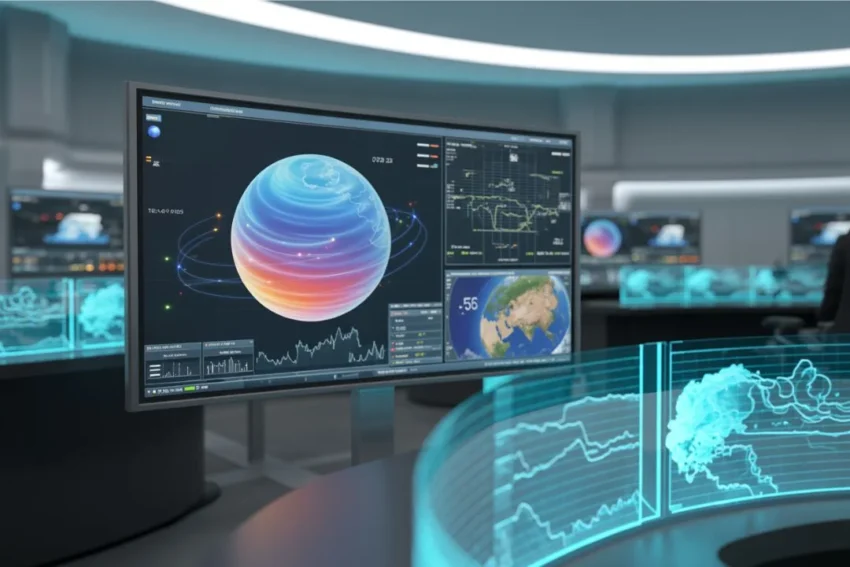
Introduction: The world of predictive systems
Human life has always been intertwined with the desire to know the future. Whether it is about the weather, business, the economy, health, or technology—humans always ask one question: “What is going to happen in the future?”
This natural need gave rise to Forecasting Systems, which are systems that use existing data, observations, computational methods, artificial intelligence, and algorithms to predict future trends.
Forecasting systems are not just estimates, but are built on scientific, mathematical and analytical foundations.
Today, no major industry, government, institution or business makes decisions without Forecasting Systems because without forecasting, every step can be a risk.
For example:
- Agriculture can fail if the weather is not predicted.
- Businesses can go out of business if demand is not predicted.
- Strategy can fail if the economy is not predicted.
- City planning is affected if traffic or population is not predicted.
It is clear from this that Forecasting Systems are not just a technical necessity but the backbone of the modern world.
What are Forecasting Systems?
In simple terms,
A Forecasting System is a system that analyzes data and makes accurate predictions about the future.
This system works on the following things:
- Collecting current data
- Seeing past trends
- Understanding patterns and behaviors
- Using computational models
- Using results to predict the future
This prediction can be of different types:
- Weather Forecasting
- Financial Forecasting
- Demand Forecasting
- Sales Forecasting
- Economic Trend Forecasting
- Health/Pandemic Forecasting
- Energy Demand Forecasting
- Population Forecasting
Different models, techniques, and systems are used for all these forecasts.
The importance of a forecasting system
The world is changing rapidly. The amount of data has increased hundreds of times. In such a situation, decisions cannot be made based on guesses or experiments.
Forecasting systems help organizations, governments, and businesses make decisions in the right direction.
Some basic aspects of importance:
Reducing Risk
- If a company knows that demand will be high next month, it will produce more.
- If it expects sales to be low, it can avoid losses.
Better resource planning
A forecasting system identifies when what will be needed:
- Electricity demand
- Water consumption
- Stock
- Employee requirements
- Budget
Better decision-making
- Governments use economic forecasts when making policy.
- Businesses analyze the stock market.
- Agriculturalists rely on weather forecasts.
Cost Reduction
- Taking the right steps at the right time always reduces losses.
- That is why forecasting systems play an important role in reducing costs.
Increased efficiency
Organizations plan better, resulting in increased efficiency.
Types of Forecasting Systems
Forecasting systems in the world are of two basic types:
Quantitative Forecasting Systems
These systems work on mathematics, statistics, data, and numbers.
Examples:
- Time Series Forecasting
- Regression Models
- ARIMA Models
- Exponential Smoothing
- Data-driven AI Models
Qualitative Forecasting Systems
These are based on experience, opinion, observation, and expert analysis.
Examples:
- Delphi Method
- Expert Opinion
- Scenario Building
- Market Research
Most organizations use a combination of both systems to make forecasts more accurate.
The Role of Data: The Heart of Forecasting Systems
The foundation of every forecasting system is data.
No forecasting system can be effective without accurate data.
Types of data:
- Historical Data
- Real-time Data
- Big Data
- Sensor Data
- Market Data
- Customer Behavior Data
Modern forecasting systems combine all of these data sources to make predictions.
Forecasting Systems and Artificial Intelligence
Artificial intelligence has given new life to forecasting systems.
Today’s advanced “AI-driven forecasting systems” understand big data without human error.
Key roles of AI:
- Automatically finding patterns
- More accurate prediction of future trends
- Real-time updates
- Reduced human error
- Improved accuracy
Today, e-commerce, finance, healthcare, meteorology, technology, traffic systems, and almost every sector relies on AI forecasting systems.
Types of Forecasting Systems and their Models
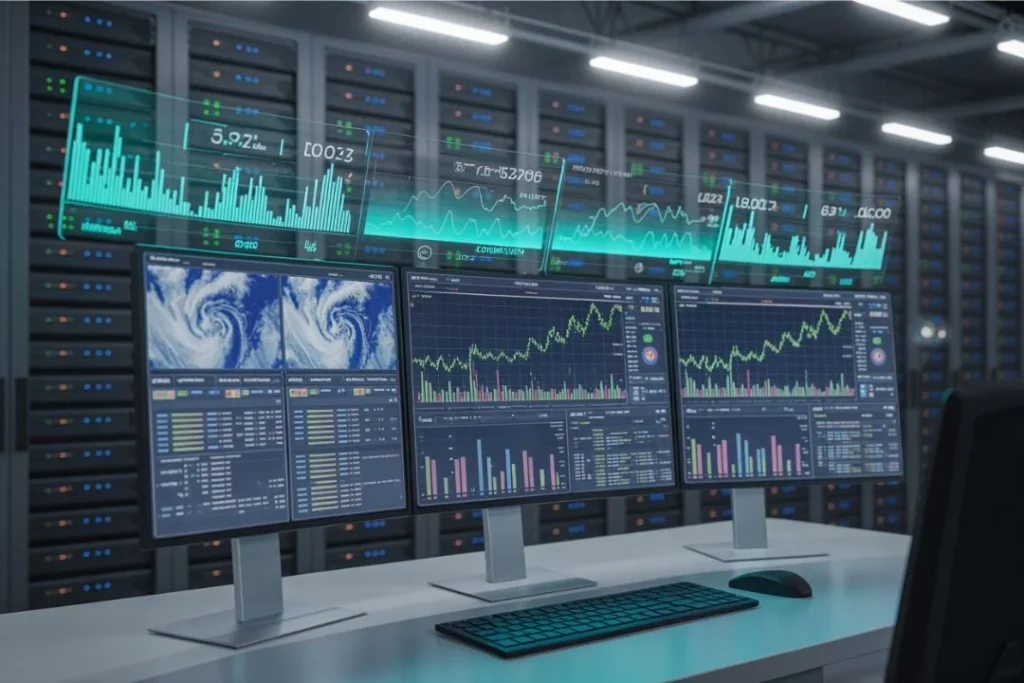
As simple as a forecasting system may seem, it is actually quite complex. Every industry, every business, every economic field, even every data set requires a different forecasting method. That is why different types of Forecasting Systems are used around the world.
The main goal of all of them is the same: to provide the most accurate possible predictions about the future.
Let us now understand in detail the types of forecasting systems and the models used in them.
Quantitative Forecasting Systems
This is the most powerful and scientific method of forecasting. Quantitative forecasting systems are based on numbers, statistics, data, graphs, trends, and mathematical formulas.
They are useful when:
- There is sufficient historical data
- Trends are clear
- Forecasts are possible based on the data
Main models of quantitative forecasting:
Time Series Forecasting Models
A time series is data that changes over time.
Examples:
- Daily sales
- Daily electricity consumption
- Daily dollar rate
- Stock market prices
- Temperature
The goal of time series forecasting systems is to find the same patterns in the future that occurred in the past.
Seasonal Models
If the data is changing frequently according to the season, months or days.
Example:
- Sales of dates in Ramadan
- Demand for geysers in winter
- Sales of ice cream in summer
Regression Models
A regression model looks at how one variable affects another.
Examples:
- Ice cream sales increase as temperatures rise
- Inflation decreases as purchases decrease
- Increased population increases as electricity demand increases
Main Regression Models:
- Linear Regression
- Multiple Regression
- Logistic Regression
This is a very powerful prediction system because it makes relationships clear.
Quantitative Simulation Models
These models generate different possible future outcomes.
- Example:
A bank wants to know what will happen if interest rates increase by 2%?
Or how will the market react if the dollar appreciates? - Monte Carlo Simulation is very popular in this.
Qualitative Forecasting Systems
- Qualitative forecasting systems are used when data is scarce, or uncertainty is high.
- They are based on experience, observation, and expert opinion.
These systems are best used in the following situations:
- After launching a new product
- When data is scarce
- When only experienced people can predict the future
- When a new trend is emerging in the market
Expert Judgment
An expert in a field is given the situation, then makes a prediction based on his experience.
Examples:
- A doctor estimates the spread of a disease by observing the situation
- An economist predicts future inflation
- A market expert identifies new trends
Scenario Building
It imagines different scenarios:
- What if the market goes down?
- What if new laws are introduced?
- What if the dollar falls?
This method is used by most governments.
Market Research
It is usually used for a new product, service, or market.
It involves:
- Consumer opinion
- Surveys
- Interviews
- Focus groups
Predictions are made through:
Big Data Forecasting
The future is predicted using very large data sets (Terabytes, Petabytes).
This system is mostly used by:
- Governments
- Large companies
- International organizations
Forecasting Systems — FAQs (Frequently Asked Questions)
What is a Forecasting System?
A forecasting system is a system that analyzes current and past data to predict future trends, outcomes, or events. This system works with the help of statistics, algorithms, machine learning, and expert opinion.
Why are Forecasting Systems important?
These systems help organizations, businesses, governments, and industries make better plans, make better decisions, reduce costs, and protect against risks. Accurate prediction of the future increases the potential for growth.
How many types of Forecasting Systems are there?
There are generally two main types:
- Quantitative – based on data and numbers
- Qualitative – based on experience, opinion and observation
In the modern era, systems based on AI, Big Data and IoT have also been added.
What is Quantitative Forecasting?
Quantitative forecasting is a method of predicting the future using statistical data, time series, graphs, numbers, and mathematical models. It is effective when there is a lot of data available.
Why is Qualitative Forecasting used?
When data is scarce or there is a new product, new situation, or new trend, then opinion and experience are essential. That is why qualitative forecasting is used.
What are the main models used in Forecasting Systems?
Important models include:
- ARIMA
- Linear Regression
- Exponential Smoothing
- Neural Networks
- LSTM Models
- Prophet Model
- Delphi Method
- Scenario Planning
What is the role of Artificial Intelligence (AI) in Forecasting Systems?
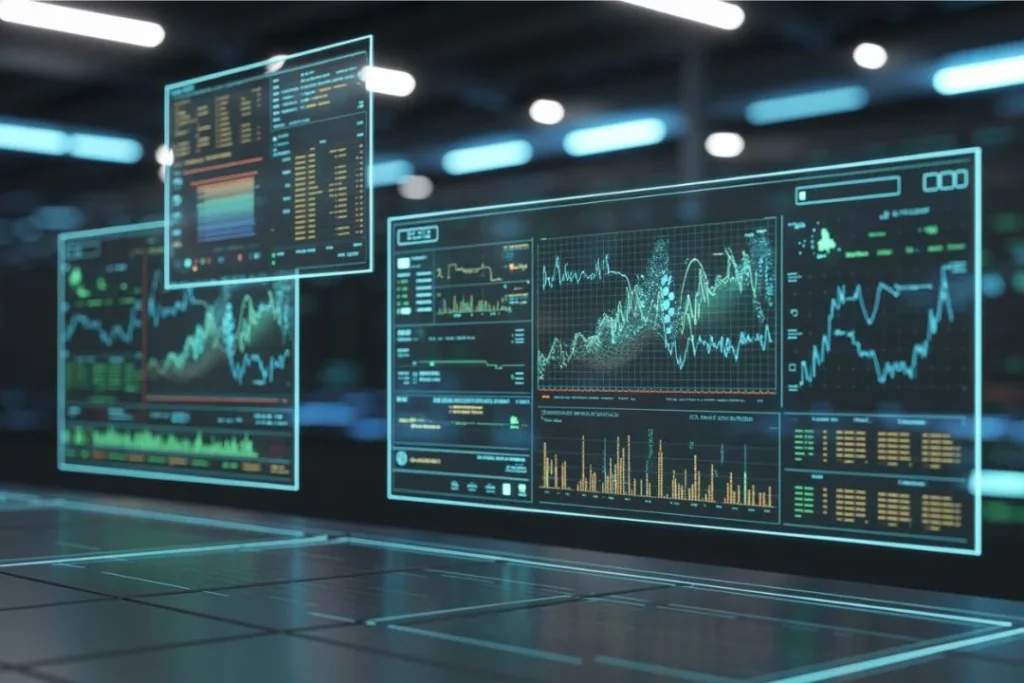
AI automatically finds patterns in big data, makes more static predictions, reduces errors, and provides real-time results. Today, almost every major industry is using AI forecasting.
(Conclusion)
Forecasting Systems have become the cornerstone of accurate understanding of the future and effective planning in the modern era. These systems help businesses, governments, and various industries make better decisions with the help of data, statistics, and artificial intelligence. Accurate forecasting not only reduces risks but also increases the chances of success.