Introduction — Reflection on Communication Skills
For centuries, the power on which man has relied the most for his survival, development, relationships, social order, and intellectual heritage is communication. The success of man’s entire life, be it at home, in the office, in educational institutions, in the business world, or in social activities—everywhere—directly depends on it.How he speaks, how he listens, how well he understands, and how effectively he can convey his message to others. These abilities are collectively called “Communication Skills”.
In today’s fast-paced world, where information travels from one corner of the globe to another in seconds, the importance of excellent communication skills has increased. This changing world has forced man to learn not only to speak but also to speak thoughtfully, effectively, and at the right time.That is why “Reflection on Communication Skills” is a process that has become essential for every learner, every professional, every student, and every responsible individual.
In this introduction, we will try to understand what communication skills actually are, how deeply important they are in human life, and why these skills carry more weight than all other skills in today’s era. At the same time, we will also see how Reflection, i.e. self-accountability and self-observation, plays a fundamental role in improving these skills.
What are communication skills?
If we define communication in simple terms, it is actually a process through which:
- we convey our message to others,
- listen to others,
- choose words,
- express emotions,
- and above all, understand the thoughts of others.
This process may seem simple, but in reality it is a very complex one, involving psychological, emotional, social, and intellectual abilities.
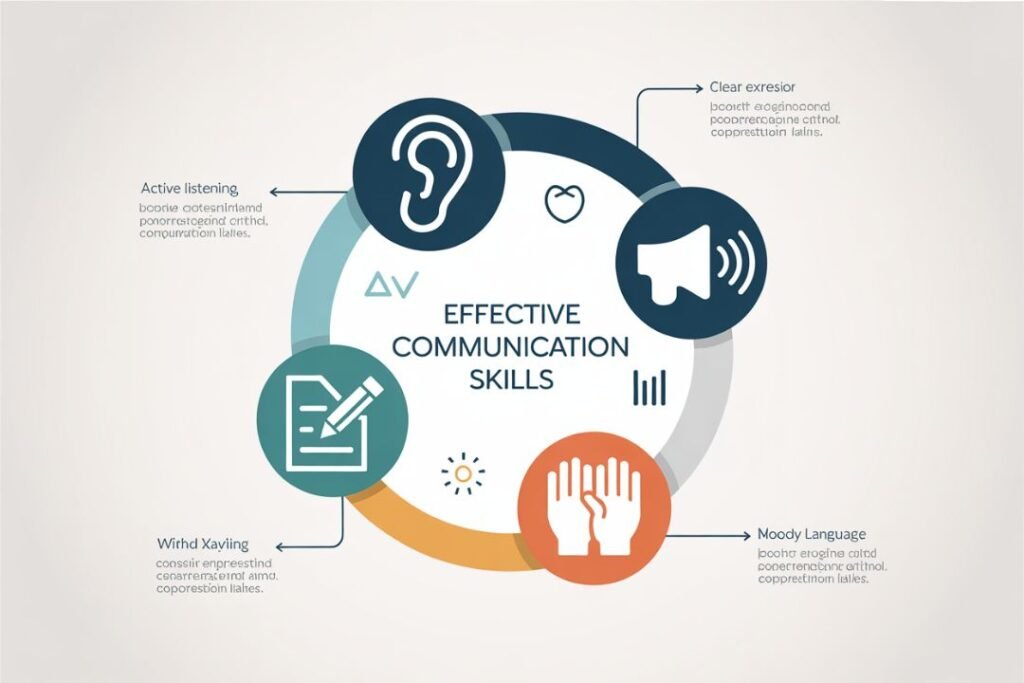
Communication skills are not just about speaking. They are a complete system that includes:
- Verbal Communication
- Non-Verbal Communication (Body Language, Hand Gestures, Facial Expressions)
- Written Communication
- Listening Skills
- Emotional Communication
- Digital Communication
- Understanding and mastering all these aspects is the foundation of a successful life.
Why is reflection important?
Just knowing how to communicate is not enough. Real success comes when we:
- Examine our speaking habits
- Identify our mistakes
- Identify our weaknesses
- Examine our attitudes
- And above all, constantly strive to improve them
This process is called Reflection.
- This process helps us understand:
- Where we speak well
- Where we misunderstand
- When our language choice is inappropriate
- What things make people feel bad
- How well we understand people
- And how others see and understand us
Without Reflection, a person will always repeat their old mistakes, while Reflection shows us the way to change and improve.
How do communication skills affect human life?
Human relationships are based on “understanding”, and understanding only arises when communication is effective. If there is a gap in communication, there is a gap in relationships as well.
For example:
- Misunderstandings between husband and wife at home often arise due to poor communication.
- A major reason for parents’ failure in raising children is the lack of proper communication skills.
- Strong teamwork in the office also depends on good communication.
- Excellent communication is essential to convince customers in business.
- The strength of the relationship between teacher and student also depends on this.
In short, communication skills are the thread of all human life that connects all relationships, achievements, and experiences.
The growing importance of communication skills in the modern era
Today is the era of the “information explosion”.
Everyone has information, everyone has technology, but not everyone can connect with each other effectively.
The reason?
The Communication Gap.
To bridge this gap, we need to improve our:
- Conversation style
- Word choice
- Body language
- And listening skills
Improve.
That is why communication skill training is given the utmost importance in companies today. Smart people are not only those who have knowledge, but also those who know how to convey their knowledge to others in the best way.
Reflection on Communication Skills—Where does this journey begin?
This journey begins:
- By understanding ourselves
- By examining our communication
- By seeing how people respond to what we say
- And where we can improve
- Reflection shows us the mirror.
- It is our silent teacher.
- It tells us the truth that people are often hesitant to tell us.
For example:
- Do I interrupt others?
- Is my tone of voice harsh?
- Do I take too long to explain?
- Do I listen to others properly?
- Do I have poor writing skills?
- Am I unable to express my feelings properly?
- These questions are the basis of Reflection.
Types of Communication Skills — Detailed and Comprehensive Analysis
Communication is such a vast and profound subject that it is impossible to describe it in a few words or a few sentences. It is that aspect of human personality that simultaneously affects many aspects of psychology, sociology, language, emotions, attitudes, and human intelligence.That is why, to understand communication skills, it is important that we examine its different types in depth, because the use of each type varies according to its time, context, environment, and need.
In this section, we will examine the 6 basic types of communication skills:
- Verbal Communication
- Non-Verbal Communication
- Written Communication
- Listening Skills
- Visual Communication
- Digital Communication
All of these types together create the personality of a complete, mature, and effective communicator.
Verbal Communication
Verbal communication is the communication in which we convey our message to others through words.
It is the first and most basic form of human communication.
Its main features:
- Clarity of voice
- Choice of correct words
- Softness or hardness of tone
- Continuity of speech
Speaking according to the occasion, environment and addressee
- Examples of successful oral communication:
- Effective lecture by a teacher
- Speaking confidently in a business meeting
- Explaining children in a positive way
- Introducing yourself in an interview
Mistakes include:
- Using inappropriate words
- Speaking too fast
- Speaking too slowly
- Lengthening the conversation unnecessarily
- Addressing others without emotion
Reflection questions:
- Do I speak with thought?
- Is my tone understandable to people?
- Do I speak in short, clear sentences?
Non-Verbal Communication
Body language, facial expressions, hand gestures, eye contact, body movements, sitting and standing posture—all of these combine to create non-verbal communication.
- It’s amazing that according to experts:
- 55% of human communication is non-verbal.
- That is, we are often sending messages without even speaking.
Examples:
- A bump on the forehead is a sign of displeasure
- Smiling = friendliness, acceptance
- Speaking with lowered eyes = lack of confidence
- Standing with folded arms = defensiveness
- Nodding = yes
Mistakes:
- Not making eye contact
- Waving hands excessively
- Talking to people while looking at their phone
- Having a stern face
Reflection Questions:
- Is my body language friendly?
- Do I maintain appropriate eye contact during conversation?
- Does my demeanor reflect confidence?
Written Communication
Writing has been the most powerful means of human knowledge and communication for centuries.
Since the advent of the digital world, everyone creates:
- Messages
- Emails
- Social media posts
- Reports
- Requests
- Assignments
- Formal and informal texts
- Every day.
These are all examples of written communication.
Characteristics of good writing:
- Clear and simple language
- Proper flow of sentences
- Error-free writing
- Clarity of purpose
- Tone appropriate to the audience
Common mistakes:
- Unnecessary details
- Use of difficult words
- Incorrect expression of emotions
- Incoherent sentences
- Inappropriate phrases
Reflections on Communication Skills – Questions & Answers (English )
What is Reflection on Communication Skills?
Reflection on Communication Skills means that a person should examine his or her own communication skills. That is, he or she should look at how he or she speaks, how he or she listens, how he or she writes, what his or her body language is like, and how his or her behavior affects others. This self-reflection helps a person recognize his or her mistakes and improve his or her communication.
Why is good communication important?
Good communication is needed in every area of life. Home, office, education, business, relationships, social environments—everywhere, communication can make or break a person’s relationships. Effective communication gives a person confidence, increases success, strengthens relationships, and reduces misunderstandings.
What are the basic types of communication skills?
There are 6 major types of communication skills:
- Verbal
- Non-Verbal
- Written
- Listening
- Visual
- Digital
Each type is important in its own right and requires its own skills.
How does Reflection help improve communication?
Reflection shows a person their mistakes. For example:
- Do I speak too fast?
- Is my tone harsh?
- Do I not let others finish their sentences?
- Do I use the wrong tone in messages?
When a person sees his mistakes, he can improve by working on them.
How is verbal communication improved?
Ways to improve verbal communication:
- Use clear and precise words
- Speak at an appropriate pace
- Use a soft and effective tone
- Keep your speech short and concise
- Be considerate of others’ feelings
What role does body language play in communication?
Body language makes up 55% of communication. That is, messages are often understood more through facial expressions, eye contact, hand movements, and body posture than through words. Good body language conveys confidence, respect, friendliness, and maturity.
FAQs — Reflection on Communication Skills (Frequently Asked Questions in English)
What is the main purpose of Reflection on Communication Skills?
Its main goal is to help people assess their communication skills, identify their weaknesses, and take steps towards better communication. This makes them more effective, confident, and understanding communicators.
What should be improved first in communication skills?
First of all, listening skills should be improved, because better listening lays the foundation for better speaking and understanding.
Is body language really that important?
Yes, of course. According to experts, a large part of communication consists of non-verbal signals. Good body language conveys confidence, respect, and a positive attitude.
How is Reflection done?
For Reflection, ask yourself:
- Do people get offended or offended by what I say?
- Do I listen to others fully?
- Is my writing clear and accurate?
- Is my body language positive?
The answers to these questions will help you improve.
What are the easiest steps to improve communication?
- Speak clearly and slowly
- Use a soft tone
- Listen attentively to others
- Use simple and clear words
- Send digital messages carefully
- Reflect for 10 minutes daily

(Conclusion)
Communication skills are the foundation of human life success and relationships. Through reflection, we can identify and improve our communication weaknesses. Improving verbal, written, nonverbal, and digital communication builds self-confidence, strengthens relationships, and helps every person become an effective and successful communicator.