Introduction:
The world is changing rapidly. Until a few years ago, artificial intelligence was like a dream, but today it has become a reality. 2026 is the year that experts are calling the “year of AI revolution.” This is the era where the gap between humans and machines will be even smaller than before.Until a few years ago, we used to just type and talk, but in 2026, AI will be able to understand our emotions, speech patterns, situations, and even needs.
In this article, you will learn:
- What will AI be like in 2026?
- What major revolutions will take place?
- What impact will it have on the lives of the common man?
- What skills will be most needed?
- And how will AI make money?
- Let’s take a closer look at this new AI era.
Why is a new era of AI beginning in 2026?
From 2023 to 2025, AI saw growth that was not possible in the previous several decades. There are three major arguments for this growth:
AI has come close to human thinking
Where previously AI would only answer questions, it can now understand human tone, mood, and emotions. That is, if you are tired, angry, or upset, AI will recognize your state and respond accordingly.
AI will be embedded in every device
By 2026, artificial intelligence will not be limited to mobile or computers, but:
- Cars
- Home appliances
- Watches
- TVs
- Medical machines
- Office systems
AI will work automatically everywhere.
AI has become capable of self-learning
Self-Learning Artificial Intelligence is the biggest revolution of 2026.
This AI can improve itself without human help, learn from mistakes and make its decisions more accurate.
The 7 Biggest AI Breakthroughs of 2026
Now for the real part…
- What changes are coming in 2026 that will change our lives forever?
- Let’s take a look at them one by one.
Early-level ‘artificial general intelligence’ (AGI) will emerge
AGI is technology that has the ability to think, understand, and make decisions on par with humans. While full AGI may not be here yet, it is expected to be in its early stages by 2026, when it will:
- be able to plan
- make decisions on its own
- analyze situations
- communicate in a human-like manner
- predict future outcomes
This will be the biggest milestone in the entire technology sector.
The healthcare sector will be completely transformed.
In 2026, the healthcare sector will be considered incomplete without AI.
What will AI do?
- Early diagnosis of diseases
- Predicting cancer, heart disease, diabetes, etc.
- Virtual doctor
- Robotic surgery
- Checking the condition of patients regularly
- Arranging treatment according to each patient
- Diagnostic accuracy will increase from 90 to 98 percent by 2026.
- This will be most beneficial in poor countries, remote areas and in emergency situations.
Fully automated vehicles will become commonplace
2026 is the year in which self-driving cars will no longer be limited to experiments but will be in general use.
What would be possible?
- Driverless taxi
- Automated truck transport
- AI traffic control
- Zero accident system
- Automated parking
- The world’s major cities will be enriched with this technology.
AI will bring the biggest change in education
The style of education will completely change by 2026.
Important Changes:
- AI teacher for every child
- Teaching according to the intellectual level of each student
- Automated homework
- Exams will be graded by AI
- AI will analyze students’ weaknesses and strengths
- This will make education faster, easier and accessible to all.
AI will play a key role in cybersecurity
Cyber attacks will also increase in 2026, but AI will combat them.
What will AI do?
- Will immediately thwart hacking attempts
- The need for passwords will be reduced
- Identification based on eyes, voice and behavior
- Automatic defense system
- The ability to prevent all kinds of mistakes
- This is the field where AI will work not on par with humans, but ahead of them.
The entire content creation industry will change.
With the help of AI:
Movies
- Music
- Stories
- Dramas
- Advertisements
- Videos
- Web design
All will be able to be created by machines — that too in high quality.
This work, which used to take weeks, will now be possible in a few minutes.
AI and robotics together will bring about an industrial revolution
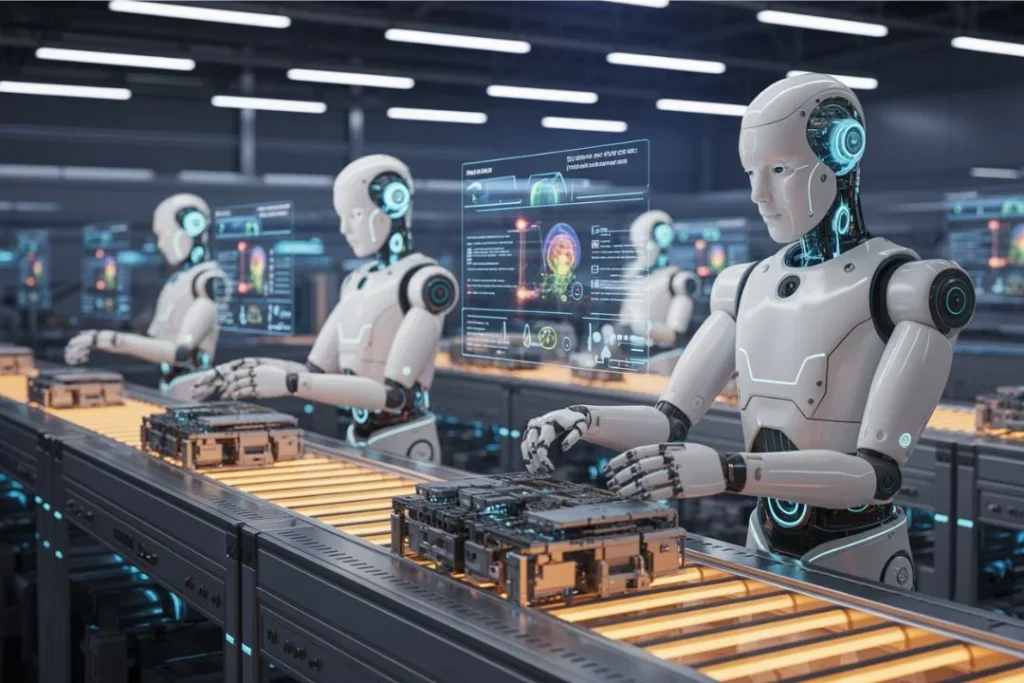
In factories:
- Automated machines
- 24-hour work
- Error-free production
- Automatic repair systems
- Smart logistics
This change will have a major impact on the economy around the world.
How will the life of the common man change?
The question on everyone’s mind is what will be the benefit to the common man?
Major changes:
- Work will become faster and easier
- Health problems will be reduced
- Travel will become easier
- Every home will turn into a smart home
- Opportunities for higher earnings
- Reduction in inflation
- The possibility of errors will almost disappear
- This era will not provide intelligence to man, but convenience
What will be the most important skills in 2026?
If you want to progress, learn these skills:
- Using AI tools
- Data analysis
- Cybersecurity
- ‘Prompt engineering’
- Cloud technology
- Using automated systems
- Creative skills
- Digital marketing
These skills will take you many steps ahead of other people.
The Process of Artificial Intelligence (How Does It Work?)
A complete internal system of machines that think like humans
Artificial intelligence is not just a phrase, it is actually an entire mental system. When we say that an AI model recognizes images, understands speech, completes sentences, or makes decisions like a human—there are many complex steps, algorithms, neural networks, and a whole system of data processing behind it.
- But this system is not as difficult as it seems.
If we compare it to the human brain, the matter becomes much simpler. - In this chapter, we will find the answer to the most basic but most important question:
- How does AI actually work?
The basic formula of AI — observe, learn, decide
There is a simple formula behind artificial intelligence:
- Observation
- Learning
- Decision
This is what humans do, this is what AI does.
- Example:
If a small child is shown “this is a cat” ten times, he will recognize it on the eleventh time. - AI does the same thing—the only difference is that it is given thousands of images, not 10.
Types of Artificial Intelligence — Different AI Models and Their Implementation
Understanding the types of artificial intelligence is the most important step in understanding it. People often think of AI as a single technology, but in reality, Artificial Intelligence is a collection of many small and large systems. Each system learns differently, works differently, and solves different problems.
In this chapter, we will understand all the basic, advanced, and future types of AI in detail.
This chapter is also written in a completely human style so that the reader can grasp everything easily.
The 3 main categories of artificial intelligence
- All AI in the world is divided into three major types:
- General AI (general or fully intelligent AI)
- Super AI (super intelligence)
These three are the basic pillars of Artificial Intelligence.
Narrow AI (Weak / Specific Artificial Intelligence)
This is AI that does just one thing.
99% of the world’s AI falls into this category.
Examples:
YouTube’s recommendation AI
- TikTok’s algorithm
- Google Translate
- Chatbots
- Face Unlock
- Selfie camera filters
- Spam email detector
Narrow AI doesn’t have full intelligence like a doctor, engineer, or human—
it just has a specific skill set that makes it great.
Why is it important?
The entire technology of the world, the entire internet, the entire mobile system is running on Narrow Artificial Intelligence.
General AI (General Artificial Intelligence / AGI)
This will be the AI that can do all kinds of work like a human.
AGI:
- Will learn on its own
- Will make decisions on its own
- Will solve problems on its own
- Will be able to make strategies on its own
- Will have human-like reasoning
AGI is not yet fully realized,
- but the world’s major companies:
- OpenAI
- Google DeepMind
- Tesla
- Meta
- Anthropic
- are working on it rapidly.
- Prediction:
- AGI is likely to arrive by 2030–2035.
- AGI Highlights:
- It won’t just be Artificial Intelligence —
It will be an artificial brain.
Super AI (Super Intelligence)
This is the Artificial Intelligence that will be millions of times more intelligent than humans.
Super AI:
- Can invent better than scientists
- Can diagnose better than doctors
- Can run a country
- Can improve war, economy, health—everything
- But…
This same Super AI can also be dangerous if it is not controlled.
Experts believe:
Super Artificial Intelligence may become a reality in 2040–2050.
7 technical types of artificial intelligence
- Now let’s look at the types of AI that are used in the world in terms of technology and work.
- This is the knowledge that a professional must have.
Machine Learning (ML)
- The heart of Artificial Intelligence is Machine Learning.
- This gives AI the ability to learn from data.
There are three major types within ML:
- Supervised Learning
- Data is pre-labeled.
- AI learns by observing it.
- Unsupervised Learning
- Data is unlabeled.
- AI finds patterns on its own.
- Reinforcement Learning
- AI learns through trial and error.
- For example:
Tesla’s self-driving system. - Machine Learning is the most widely used Artificial Intelligence today.
Deep Learning
- This is the next level of Machine Learning.
- Neural networks like the human brain are used.
Deep Learning:
- Recognizes images
- Understands voice
- Reads language
- Drives a car
This is Deep Learning → The basic system of ChatGPT, Google Lens and Tesla Autopilot.
Artificial Intelligence — Focus (Most Asked Questions)
What is Artificial Intelligence?
Artificial Intelligence or AI is the technology that gives computers and machines the ability to think, learn, understand, and make decisions like humans.
It can recognize images, understand speech, write text, and solve complex problems.
How does Artificial Intelligence become more intelligent than humans?
AI does not get tired like humans, makes fewer mistakes, can remember a lot of data, and can perform thousands of calculations in an instant.
That is why AI performs faster and better than humans in some tasks.
In which fields is Artificial Intelligence used?
AI is being used almost everywhere:
- Mobile phones
- Health (medical)
- Banking
- Educational institutions
- Internet
- Factories
- Security systems
- Transport
It has become an important part of our daily lives.
Will Artificial Intelligence eliminate human jobs?
AI will certainly replace some jobs, but it will also create thousands of new ones—
For example:
- AI trainer
- Data analyst
- Robotics engineer
- Machine learning specialist
Those who learn new skills will have a secure and bright future.
What is Generative AI?
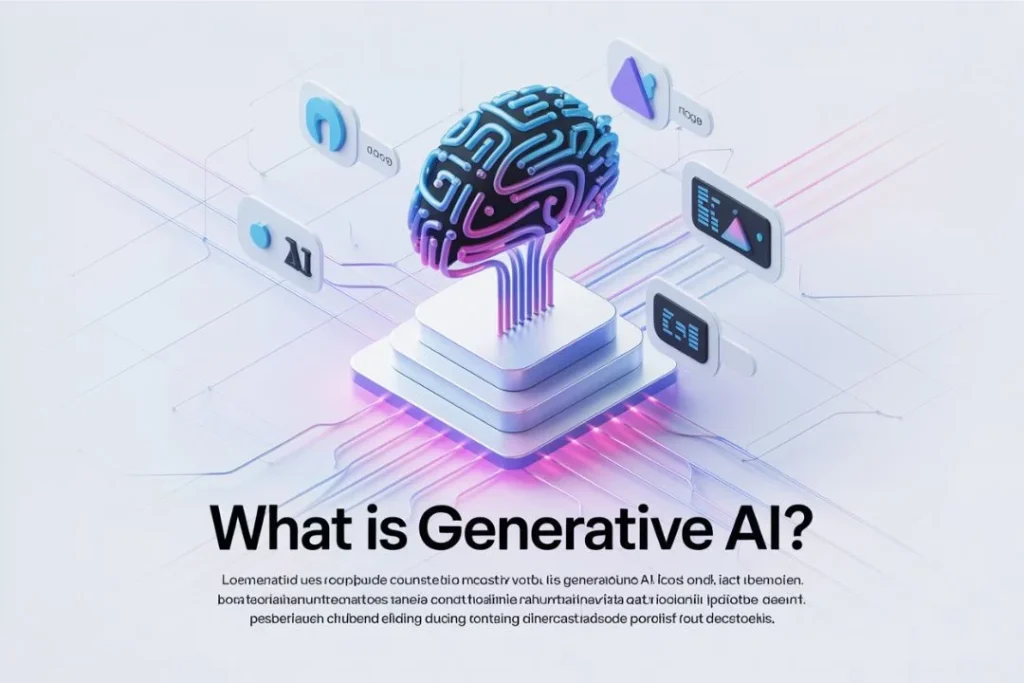
Generative AI is Artificial Intelligence that creates new content such as:
- Writing (ChatGPT)
- Images (Midjourney)
- Videos (Sora)
- Music (Suno)
- 3D Design
This AI does not imitate human creativity but creates new and unique content based on learned data.
(Conclusion)
Artificial Intelligence is rapidly changing our lives. This technology is not here to compete with humans, but to help them. In the coming years, AI will make our jobs, businesses, healthcare, education, and everyday tasks easier and more efficient than ever before.Those who learn AI over time will be successful in the future. In short, AI is the technology that is giving the world a new direction — and the future is not possible without it.