
(Introduction)
“Space docking” is a very important concept in the world of space exploration and travel. Just as two vehicles or ships on Earth connect to each other at some point, the process of connecting different spacecraft or stations in space is called space docking. This process is not only essential for the success of space missions but is also extremely important for keeping human life safe in space.
Space docking allows different spacecraft to receive supplies from each other, enables crew exchange, and promotes cooperation across missions. For example, when a space shuttle docks with the International Space Station (ISS), it not only enables the delivery of fuel or food, but also creates new opportunities for space exploration.
The importance of space docking in space can be gauged from the fact that without docking, large and complex missions such as human missions to Mars or the Moon are not possible. Each docking is a technical challenge, because in space there is no air or friction that can slow down the ship, and each movement is extremely careful and precise.
The importance of Space Docking
- Space station supplies: Space stations can be supplied with fuel, food, and other essential supplies through space docking. For example, Russian Soyuz or SpaceX’s Dragon capsule docks with the ISS and supplies the station with essential supplies.
- Crew Exchange: Space docking is a must during the exchange and training of astronauts from different countries. This process must be carried out without any hindrance so that human lives are safe.
- Scientific experiments and research: Space docking allows scientists to conduct joint experiments during different missions. For example, an experimental laboratory can be docked with the ISS to obtain new materials and research.
- Success of space missions: Docking is essential for missions to Mars or the Moon to enable fuel transfer and the safe return of the crew. Without docking, these missions are practically impossible.
Historical background
Space Docking in Early Space Missions
The concept of docking in space emerged in the mid-twentieth century, when the United States and Russia embarked on human space exploration. Early docking missions were generally based on mechanical and available systems, which were carried out with great care.
First successful docking in 1966:
The first successful docking of two unmanned spacecrafts in a Russian program took place in 1966. This proved that two spacecraft could dock in space without incident. This achievement laid the foundation for future human missions.
Famous docking mission
- Gemini Program (USA):Docking was first fully tested in human space during the 1960s during the US Gemini program. Through this program, astronauts learned docking techniques and refined them for missions to the ISS and the Moon.
- Apollo Program: Docking played a key role during the Apollo missions during the Moon landing. Before reaching the Moon, it was necessary to dock the Command Module and the Lunar Module so that the astronauts could return safely to Earth.
- Soyuz Missions (Russia):
The Russian Soyuz spacecraft is famous for docking. This docking is not only used for resupplying the ISS but also plays a key role in crew transportation.
Initial technical aspects of Space Docking
The initial docking involved some basic elements:
- Rendezvous:
This phase ensures that the two spacecrafts come close to each other. - Approach:
Before docking, the spacecraft slowly approaches the docking site. - Capture:
During docking, one spacecraft mechanically or magnetically grabs the other. - Docking Lock:
Finally, docking is complete and the two spacecraft are securely connected.
Space Docking: Technology, Mechanisms, and Advanced Missions
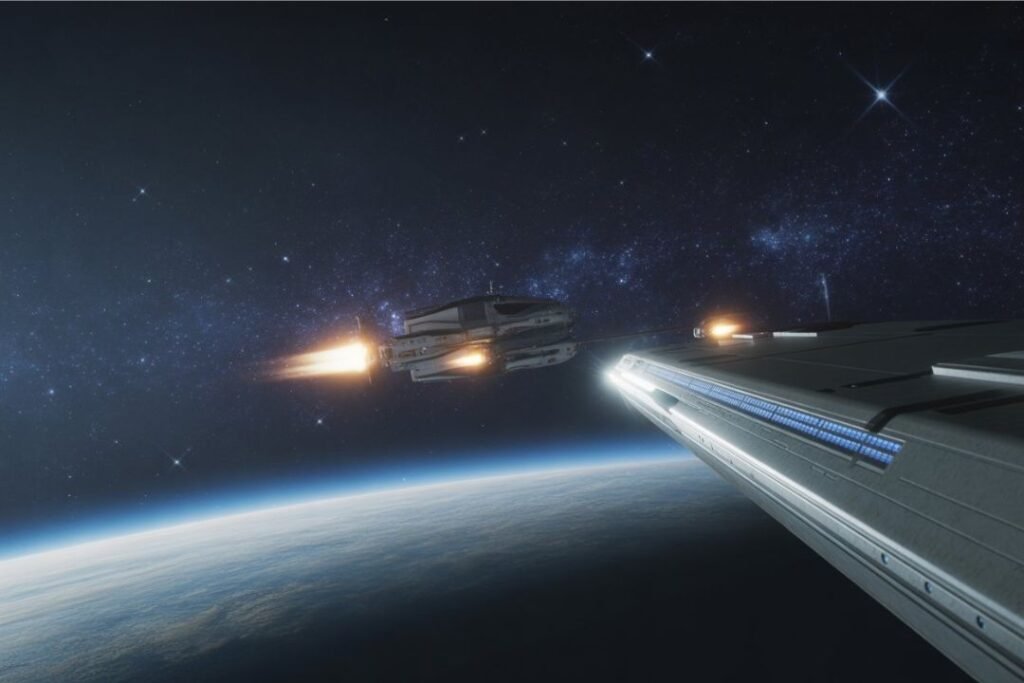
Technology and Mechanisms
Space docking is a complex and technical process that requires advanced equipment and systems. There is no air or friction in space, so every movement in docking is extremely careful and precise.
Mechanical Docking
- Mechanical docking uses flexible or rigid structures to physically connect two spacecraft to each other.
- Probe and Drogue System:
This is the oldest and most well-known mechanical docking system. One spacecraft has a probe and the other has a drogue, which connect to each other to complete the docking. - Capture Latches:
After docking, the locks or latches firmly connect the two spacecrafts so that no movement occurs.
Magnetic Docking (without mechanics)
Modern docking systems also include the concept of magnetic docking, where spacecraft are brought closer together and connected using magnets. This method produces less vibration and is suitable for small or delicate modules.
Automated Docking Systems
In today’s missions, docking is mostly done using automated systems:
- Sensors and Cameras:
During docking, various sensors and cameras are used to ensure that the spacecraft approaches the docking location at the correct angle. - Onboard Computers:
A computer on each spacecraft automatically controls the docking phases, such as rendezvous, approach, and capture. - GPS and Orbital Mechanics:
Accurate GPS and orbital calculations guide the trajectory during docking.
Human-involved Docking
Some missions also require human intervention during docking, especially when unexpected situations arise.
- Astronauts manually adjust the spacecraft using special controls.
- This method is more dangerous but necessary in some situations.
Space Docking in Modern Missions
International Space Station (ISS)
Docking at the ISS has become a common mission every day:
- Cargo Delivery:
SpaceX Dragon, Progress, and other spacecraft dock with the ISS to deliver supplies. - Crew Transfer:
Crew members dock via Soyuz or SpaceX Crew Dragon and begin work on the ISS. - Docking Ports:
- The ISS has multiple docking ports to allow different spacecraft to dock simultaneously.
Space Shuttle Docking
Docking was used during human missions during Space Shuttle missions:
- Docking between the Shuttle and the ISS or other modules was done with extreme precision.
- Docking also required the use of the Shuttle’s robotic arm.
Soyuz Docking (Russia)
Russia’s Soyuz spacecraft are best known for docking:
- Soyuz includes both manual and automated docking methods.
- These spacecraft are used to dock with the ISS for crew transfer and emergency evacuation.
Commercial Docking
Now new companies like SpaceX and Blue Origin have tried to bring docking to a commercial level:
- During space tourism, passengers can reach the ISS or orbital hotels through docking.
- Docking has become safer and easier due to automated docking systems.
Space Docking: Summary and Practical Implications
Summary
Space docking is the process of connecting two or more spacecraft in space. It is not only a demonstration of technical skill but also essential for the safety of human life in space and space exploration.
The first docking in history was done by Russian unmanned spacecraft in 1966, and was later further developed by the US Gemini and Apollo missions. Now, ISS, SpaceX, Soyuz and other missions are not possible without docking.
The basic steps of docking include:
- Rendezvous
- Approach
- Capture
- Soft Docking
- Hard Docking
These steps are not possible without complete precision, sensors, cameras, and occasional human intervention.
Important Points
Technical importance of docking:
- It brings the spacecrafts into proper alignment.
- Used in both automated and manual systems.
Risks and challenges:
- Technical failures, collision risks, and communication issues are the biggest challenges during docking.
- Microgravity and vacuum conditions make docking more complicated.
Future prospects:
- Docking will be essential for commercial space docking, Mars missions, and orbital hotels.
- Advanced AI, robotics, and magnetic systems are making docking safer and more efficient.
Role in human life and research:
- Crew transfer, supplies delivery, and scientific experiments are not possible without docking.
- Docking is a fundamental pillar for human survival in space.
Practical implications of space docking
The practical implications of space docking are vast and important:
- Success of space missions:
Major missions such as Mars or lunar missions cannot be completed without docking. - Science and research:
With the help of docking, various scientific modules can be connected to the ISS or other space stations, making new experiments and research possible. - Commercial Space Travel:
In the future, docking will be essential for orbital hotels and space tourism. - Human survival and safety:
Docking can safely transport crew members in emergencies.
The result
Space docking is not just a technical process, but the foundation for human exploration, life, and future missions in space.
It gives humans the freedom to explore beyond Earth, and is essential for commercial and interplanetary missions.
Each docking is a small but important step that will make human presence on Mars, the Moon, and other planets possible in the future.
The importance of space docking cannot be overlooked, as it is the backbone of human space travel, whether it is current ISS missions or future interplanetary colonization projects.
Space Docking FAQs (Frequently Asked Questions)
What is space docking?
Space docking is the process of connecting two or more spacecraft in space. It is essential for human missions, supply delivery, and scientific experiments.
Why is space docking important?
Space missions cannot succeed without docking. It is essential for crew transfer, food and fuel delivery, and science experiments.
What are the stages of space docking?
The basic steps of Docking are as follows:
- Rendezvous
- Approach
- Capture
- Soft Docking
- Hard Docking
Is space docking automatic or does it require human intervention?
Docking can be done in two ways:
- Automated Docking: via computers and sensors
- Manual Docking: via human intervention, in special circumstances
What are the risks of space docking?
Risks during docking include:
- Technical failures
- Collision risk
- Communication issues
Difficulties of microgravity and vacuum conditions
What missions use docking?
Docking is used in important missions such as:
- International Space Station (ISS)
- Apollo Missions
- Soyuz spacecrafts
- SpaceX Dragon and other commercial missions
What will be the importance of docking in the future?
Docking will be essential for future commercial space travel, orbital hotels, and human colonization of Mars and other planets. Advanced AI and robotics will make docking safer and more efficient.
(Conclusion)
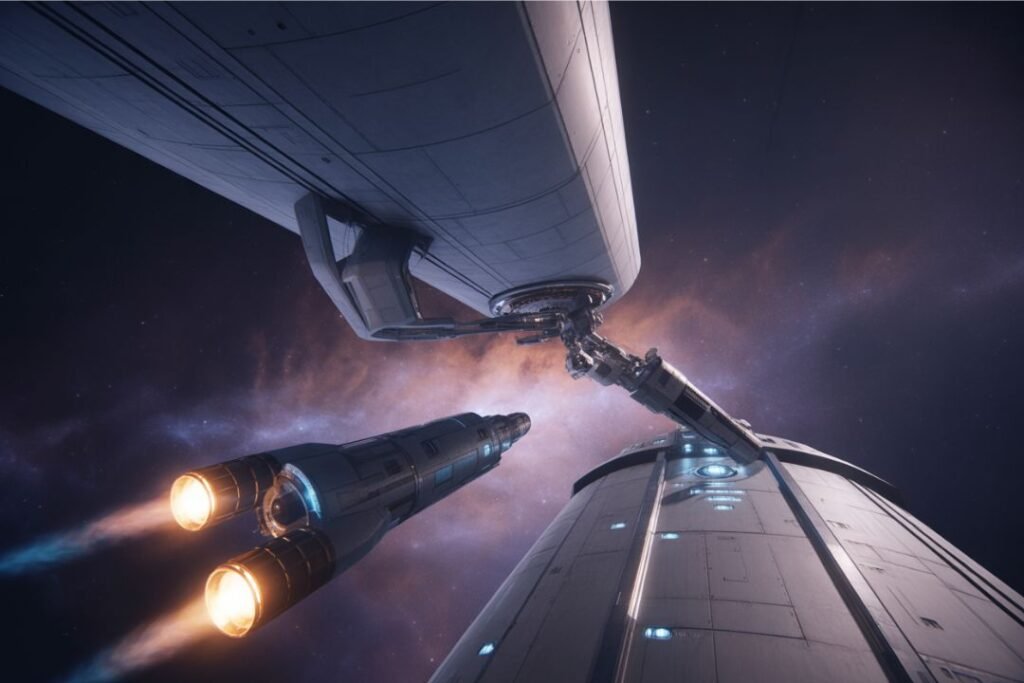
Space docking is fundamental to the success of human missions and research in space. This process enables the safe docking of spacecraft, crew transfer, and supply delivery. In the future, docking will be essential for commercial space travel, missions to Mars, and orbital colonies, and advanced technologies will make it safer and more efficient.