
Introduction to Communication Science
Communication science is a vast and constantly evolving field that studies the transmission of information, thoughts, emotions, intentions, and behaviors between humans. Humans enter the process of communication from the moment of their birth. When a baby cries, its crying is also a type of nonverbal communication.As he grows up, he learns language, learns gestures, learns to express emotions, and thus communication becomes the main pillar of his personality. Communication science came into being to understand, examine, and improve this process on a scientific basis.
Communication is a fundamental necessity in every field of human society—survival, development, civilization, knowledge, relationships, politics, business, education, technology. Without communication, humans become isolated, societies break down, systems come to a standstill, and the process of development comes to a standstill. That is why it would not be wrong to say that communication science is not just a subject but the foundation of human existence.
The importance of communication
Communication is not just about conveying information. It is a comprehensive system for building relationships, solving problems, teaching and learning, understanding emotions, establishing social rules and advancing the process of development.
- A leader creates unity among his people by communicating with them.
- A teacher awakens the intelligence of his students by communicating with them.
- A doctor understands a patient’s illness by communicating with them correctly.
- A parent shapes the personality of their children by communicating with them.
Similarly:
- Media delivers news to the public
- Social media shapes public attitudes
- Companies grow business by communicating with consumers
All of these are included in the realm of Communication Science.
Modern world and communication science
Technology has made communication more important. Today we can:
- Send messages around the world with a single button,
- See people sitting hours away on video calls,
- Connect with the world through social media,
- Talk to Artificial Intelligence.
All of this has been made possible by the collaboration of communication science, engineering, psychology, and technology.
History of Communication Science
History background
When we examine the history of communication science, we realize that communication has been the primary need of man. Ancient man lived in caves, hunted, but still he needed to communicate. There was no language, no writing, no technical means — but communication still existed.He conveyed his message to others through hand gestures, facial expressions, body language, and sounds. These were the early foundations that went on to contribute to the construction of the modern form of Communication Science.
Communication of ancient man
Communication science experts agree that when humans became capable of generating complex thoughts and feelings in their minds, they also had to develop ways to transmit them to others.
At a basic level, humans:
- Shout
- Voice
- Hand gestures
- Facial expressions
- Body movements
- Used.
These were all early forms of non-verbal communication.
Cave paintings — the first written message
Pictures of animals, hunting scenes, and humans are found on the walls of caves in different parts of the world. Experts say that these pictures were a means of:
- conveying messages
- teaching
- and preserving experiences
That is, humans were already using visual communication at that time.
The development of communication in ancient civilizations
Egyptian Civilization — Hieroglyphics
Hieroglyphic writing in Egypt revolutionized communication. It was a pictorial symbol used to:
- decisions
- laws
- religious writings
- stories of kings
- preserve.
It was one of the world’s earliest writing systems.
Mesopotamia — The First Complete Writing
The people of Mesopotamia wrote cuneiform on clay tablets. This writing was used for:
- Trade
- Transactions
- Law
- Cultural information
It was an early form of organizational communication.
Chinese Civilization — Symbolic Writing
The Chinese used pictographic and symbolic writing, which later gave rise to the world’s largest written language.
It became a means of public education, religious texts, and the promotion of philosophy.
The evolution of spoken language
Before writing, humans relied solely on oral communication.
Over time, language began to give a formal form to:
- sentences
- rules
- words
- meanings
The invention of language laid the foundation for communication science
Because now:
- Knowledge could be passed on
- Stories were passed down from generation to generation without interruption
- Social connections were strengthened
- Society was unified
This was the period when humans first created collective consciousness.
The Evolution of Written Resources
The Use of Papyrus
In Egypt, papyrus made writing easier. People could now:
- Write letters
- Keep government records
- Send detailed messages
Invention of Paper (China)
The invention of paper provided man with:
- an easy
- cheap
- secure
- means of communication.
This was an important milestone in the foundation of Communication Science.
The Printing Press — The Communication Revolution
When Gutenberg invented the printing press in 1450, the greatest communication revolution in history occurred.
Effects of this invention
- Knowledge became widespread
- Books became cheap and available
- Global connectivity increased
- Religious and philosophical ideas spread
- Journalism came into being
- Mass Communication began
This period is considered the beginning of the scientific development of Communication Science.
Modern technology and communication
Telegraph — The First Electronic Communication
In the 1800s, the telegraph made:
- Long-distance
- Instant messaging
- Military communications
possible.
Telephone — Voice Transmission
- Alexander Graham Bell put the idea of transmitting voice through electricity into practice.
- Now, for the first time, humans could:
- Speak directly over distance
Radio and Television
Both of these became the strongest foundations of mass communication.
Radio disseminated:
- News
- Music
- Education
TV took:
- visual communication
- visual messaging
- awareness
to a new level.
Internet — A New Era of Communication Science
The advent of the Internet after 1990 changed the world completely. Now:
- Everyone is connected to global information
- Social media came into being
- Digital relationships began to form
- Mobile communication made contact permanent
The Internet made communication:
- Fast
- Cheap
- Unlimited
Social media — the most powerful means of modern communicationSocial media — the most powerful means of modern communication
- Twitter (X)
- TikTok
has made communication a part of human life.
This is the era where Communication Science:
- Psychology
- Social science
- Technology
- Marketing
- Politics
All combined have taken on a new form.
The role of Artificial Intelligence in the present era
Today AI:
- Understands language
- Detects human emotions
- Automates messages
- Creates chatbots
- Creates virtual assistants
It’s all a combination of communication science and technology.
Summary
The history of communication science tells us that:
- Man has always been in need of communication
- Every new invention has made communication easier
- Every era has modernized communication science
Today, this field is the foundation of every system in the world.
Basic Theories of Communication Science
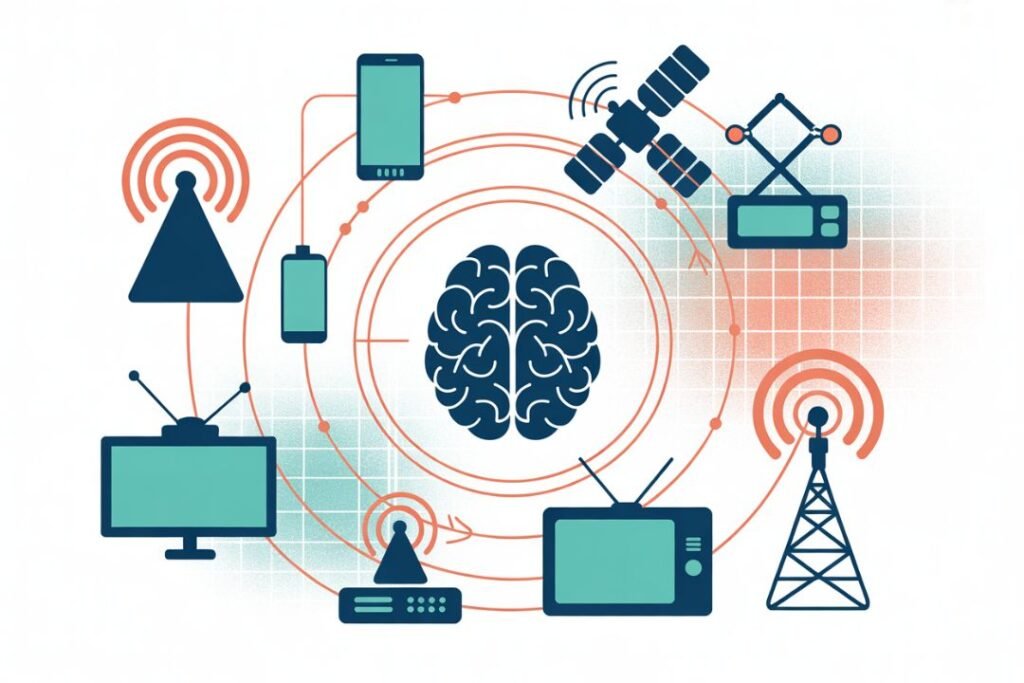
Communication Science is not just the study of messaging but a complete scientific framework based on various theories, models, experiments, and observations. Researchers around the world have proposed several important theories to understand the communication process, on the basis of which the principles of modern media, social media, mass communication, and interpersonal communication were established.
Below is a description of the most important and fundamental theories of Communication Science.
Shannon-Weaver Model — the first scientific model of communication
This model was introduced in 1948 by Claude Shannon and Wyvern Weaver.
It is also called the Mother of Communication Models.
The basic components of this model are:
- Information Source
- Transmitter
- Signal
- Channel
- Noise
- Receiver
- Destination
According to this model:
Communication is a linear process where one sender transmits his message to another through a channel, but during this time, noise or obstacles can distort the message.
Example:
- The signal is distorted while watching TV → this is noise.
- This model is still considered the foundation of Communication Science.
Circular (Transactional) Communication Model — Two-way communication
This model is different from Linear.
According to it, communication is a two-way process.
Components:
- Both sender and receiver influence each other
- Feedback is essential
- Context is important
Example:
- Two people are having a conversation.
- One speaks → the other responds.
- This is the basic theory of modern interpersonal communication.
Two-Step Flow Theory — The Role of Opinion Leaders
This theory emerged between 1940 and 1950.
According to it:
- The media first influences Opinion Leaders
- Then these leaders further influence the public
Examples:
- Social Media Influencers
- Religious or Political Leaders
- Celebrities
If the media promotes something, the public is not influenced directly but through the leaders.
Agenda Setting Theory — The media decides what we will think
This theory was proposed by Maxwell McNabs and Shosho in 1972.
According to it:
- “The media does not tell the public what to think,
- but it does tell them what to think about.”
- That is, the media decides which topics are important.
This theory was proposed by Maxwell McNabs and Shosho in 1972.
Example:
- Someday news channels only talk about inflation → the public will also talk about it
- Someday cricket is featured prominently → the same topic dominates
- This theory is also used today to understand social media trends.
Communication Science — FAQs (Questions and Answers)
What is Communication Science?
Communication Science is the scientific field that studies the exchange of information, emotions, intentions, and messages between humans. This field also understands language, media, technology, sociology, psychology, and behavior.
What is the difference between Communication and Communication Science?
- Communication: The process of giving and receiving messages
- Communication Science: The knowledge, theories, and research to understand this process on a scientific basis
Why is Communication Science important?
This is important because:
- It improves our communication
- Reduces misunderstandings
- Helps understand the effects of media
Improves social media, organizational systems, and mass communication.
In which fields is Communication Science used?
- Media & Journalism
- Social Media Management
- Human Resources
- Education
- Marketing
- Public Relations
- Politics
- Business & Corporate Communication
What are the basic elements of communication?
- Sundar
- Message
- Medium
- Receiver
- Feedback
- Grandchildren
- Vanisht
- Encoding & Decoding
(Conclusion)
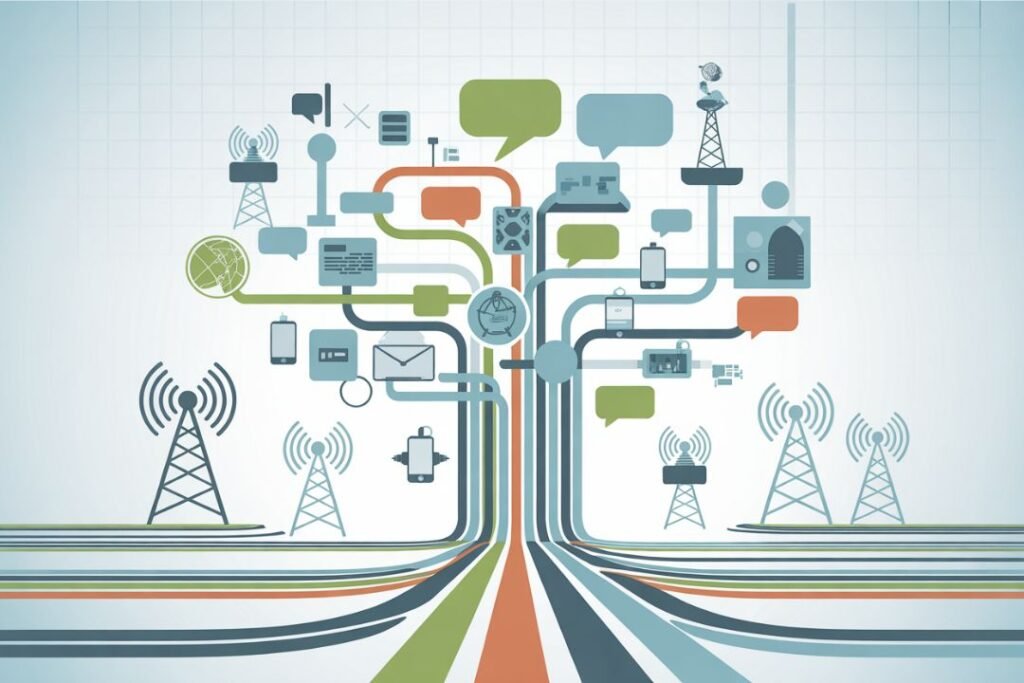
Communication Science is the scientific study of effective communication between humans, understanding the transmission of messages through language, movement, media, and digital technology. This field explains information, attitudes, and social changes in the modern era. Better communication not only strengthens relationships but is also a fundamental pillar of education, business, and the development of society.