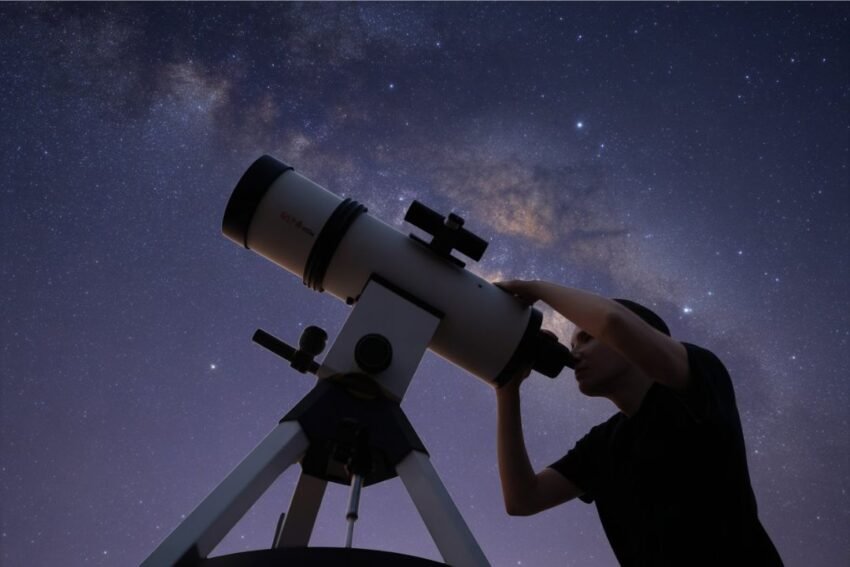
What is astronomical observation?
The importance of astronomical observation lies in the fact that it provides us with information about the world beyond Earth, such as the composition of a planet, the brightness of a star, or the distance to a galaxy. Without it, astronomy remains a discrete theory, while observation gives practical form to this knowledge.
The importance of astronomical observation
Astronomical observation dates back to the earliest periods of human civilization. Ancient people used the night sky to make weather predictions, estimate the time, and plan for agricultural activities. Similarly, astronomical observation today helps scientists study new planets, solar flares, and other cosmic phenomena.
These observations have not only revolutionized the field of astronomy, but also help us understand how our planet Earth orbits the Sun, and where we stand in the universe. Thanks to astronomical observation, we can study black holes, supernovae, and distant galaxies, which are of incredible importance to human knowledge.
The main objectives of astronomical observation
- Increasing knowledge: Gaining knowledge about the universe and expanding human understanding.
- Technological advancement: Instruments and methods of astronomical observation are always giving rise to new technology, such as advanced telescopes and space missions.
- Scientific research: Observation is essential to verify or improve scientific theories.
- Fulfilling human curiosity: The human mind has always sought to know where we are in the universe, and astronomical observation is the best way to satisfy this curiosity.
Historical background
Ancient human history and observing the sky
Since the beginning of human history, humans have gazed at the heavens—the dark night sky, the moon, the sun, the stars, and the moving planets have been the focus of human curiosity. For early humans, the movements of celestial bodies played an important role in the light and darkness of the night, the changing seasons, the harvesting of crops, and other daily necessities.
Some ancient signs—such as inscriptions on rocks, petroglyphs, or disks depicting celestial bodies—the sun, moon, stars—tell us that man looked up at the sky not only with wonder but also with the intention of observation and measurement.
On this basis, astronomical observations began to be made for calendars, to predict the seasons, and for religious or cultural purposes. Because day, night, seasons, crops — everything was linked to the movements of the sky.
The first systematic astronomical observations: Babylonian and Mesopotamian civilizations
Historically, systematic and documented astronomical observations probably began in ancient Babylon. Babylonian astronomers carefully observed the movements of the planets, stars, moon, and sun in the night sky and recorded them on clay tablets.
The planets that were visible to our eyes—such as Mercury, Venus, Mars, Jupiter, Saturn, etc.—were identified by the Babylonians and their motions were recorded against the stars.
These records and observations led to the discovery of interplanetary motions, the arrangement of stars, the observation of the moon and sun, the dating of solar or lunar eclipses, and calculations of the seasons. Thus, the ancient Babylonians are considered the first systematic researchers of astronomy.
Greek, Greco-Roman and later Islamic periods: the development of astronomy
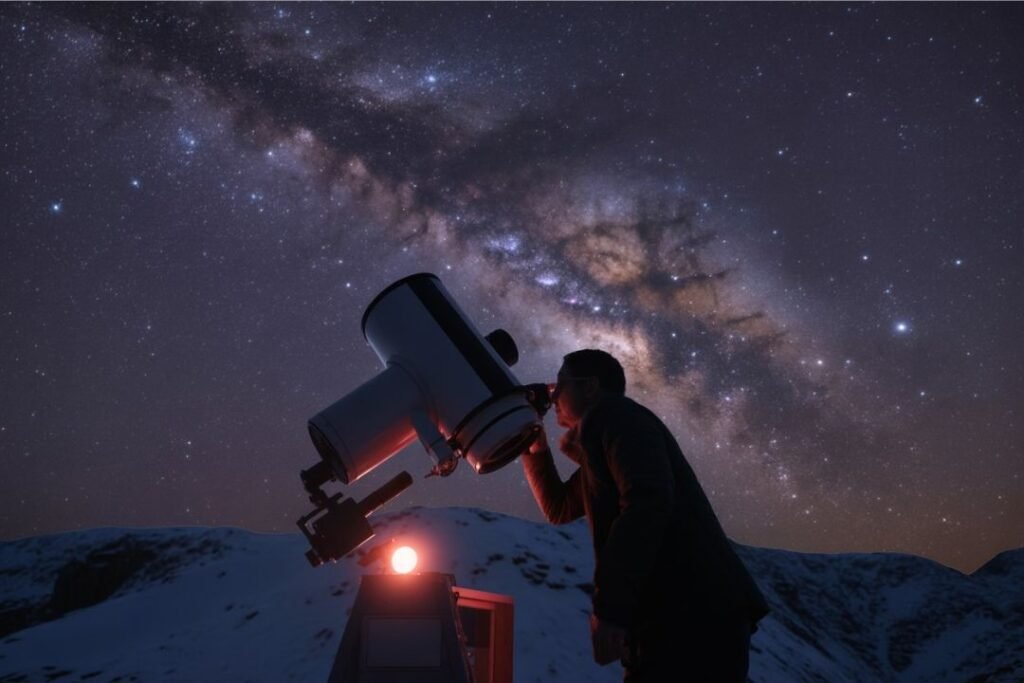
Ancient Greece (and later the Roman world) adopted the astronomical legacy of Babylon and the Middle East and built it on a more mathematical and theoretical foundation.
A famous ancient astronomer was Hipparchus, who established an observatory on the island of Rhodes around 150 BC. There he measured the positions of stars, listed them by brightness/magnitude, and compiled a detailed star catalogue, which included about 850 stars.
Hipparchus also discovered that the location of the north celestial pole had changed from centuries earlier—that is, the position of the stars changed over time. This discovery was of great importance for later astronomy and theories of the motion of the Earth.
Thus, Greek astronomy built past observations on a solid mathematical and scientific foundation.
Conclusion: The history of the observed sky—a continuum
The Babylonian civilization was the first to establish systematic astronomical observations and recordings.
- Later, Ancient Greece and Greek scientists presented analyses and mathematical models — such as Hipparchus’ star catalog and star ratings.
- Observatories were established during the Islamic period, astronomy and astronomy flourished, and this knowledge gained the status of stable institutions and research systems.
- In the 17th century and beyond, telescopes and modern instruments took astronomy to new heights, and made observing the sky a milestone in the world of science.
Thus, the history of astronomical observation spans almost thousands of years — a series that began in homes, houses of worship, deserts, and high observatories, and has reached the cosmic research and observations of the modern era.
Astronomical Observation—Instruments
Before the modern era — the naked eye and early tools
In the early days, before the invention of telescopes, humans could only observe the sky with the naked eye. The weather, the position of the stars, the rotation of the moon, and the movements of the planets—all were determined by eye.
In addition, in ancient times, simple instruments such as sundials, astrolabes, quadrants, etc. were used to estimate the movement and position of stars and solar bodies. But these methods were limited in distance, illumination, or depth/detail.
Therefore, when a device like the telescope was discovered in the 17th century, astronomical observation entered a new era.
Telescope — the basic instrument of astronomical observation
- Identification and Importance of Telescopes
A telescope is the most important instrument for astronomical observation. A telescope collects the light from objects far away from Earth—such as stars, planets, galaxies, nebulae, etc.—and makes them so large and clear that even things invisible to the human eye become visible. - Refractor vs Reflector Telescopes
There are two main types of telescopes: refractors and reflectors. Refractors use glass lenses, while reflectors use curved mirrors. Today, most large and powerful reflector telescopes are used in scientific astronomy.Because mirrors can be made in larger sizes and reflect light better. - Telescope Performance — Gathering Light and Showing Detail
Since telescopes gather much more light than the human eye, they enable us to see even distant and faint objects. For this reason, telescopes have significantly advanced astronomical observation.
FAQS
What is astronomical observation?
Astronomical observation refers to the process by which we study the stars, planets, moon, sun, or other astronomical objects in the sky, day or night. This observation can be done with the human eye, or with the help of telescopes and modern instruments.
Is an expensive telescope necessary for astronomical observation?
It is not always necessary to have an expensive telescope. If you only want to see bright stars, the moon, or large planets, the naked eye or binoculars are sufficient. But if you want to see deep celestial objects (distant galaxies, nebulae, etc.), a telescope with a large aperture (lens/mirror size) is better.
Why does the sky look dim at night — that is, why aren’t there many stars visible?
The biggest reason is light pollution, i.e. human-made lighting (streets, roads, houses); this causes the night sky to become brighter and obscures faint stars or galaxies. If you choose a location that is away from the city, with less light, the sky will look better.
Why do we see distant galaxies, black holes, or even nebulae through a telescope?
Telescopes (especially those with large apertures) collect more light, allowing us to see fainter and more distant celestial objects. Some modern telescopes record light using images or digital detectors / CCDs, which is not possible with the human eye. This allows us to see distant galaxies, nebulae made of gas and dust, and other astronomical phenomena.
Is astronomical observation only done at night?
Most observations are made at night, because stars, nebulae, galaxies, and various astronomical objects are more visible in the dark. However, observations are also possible during the day — for example, of the Sun or nearby planets. However, special protective measures (such as solar filters) are essential when viewing the Sun.
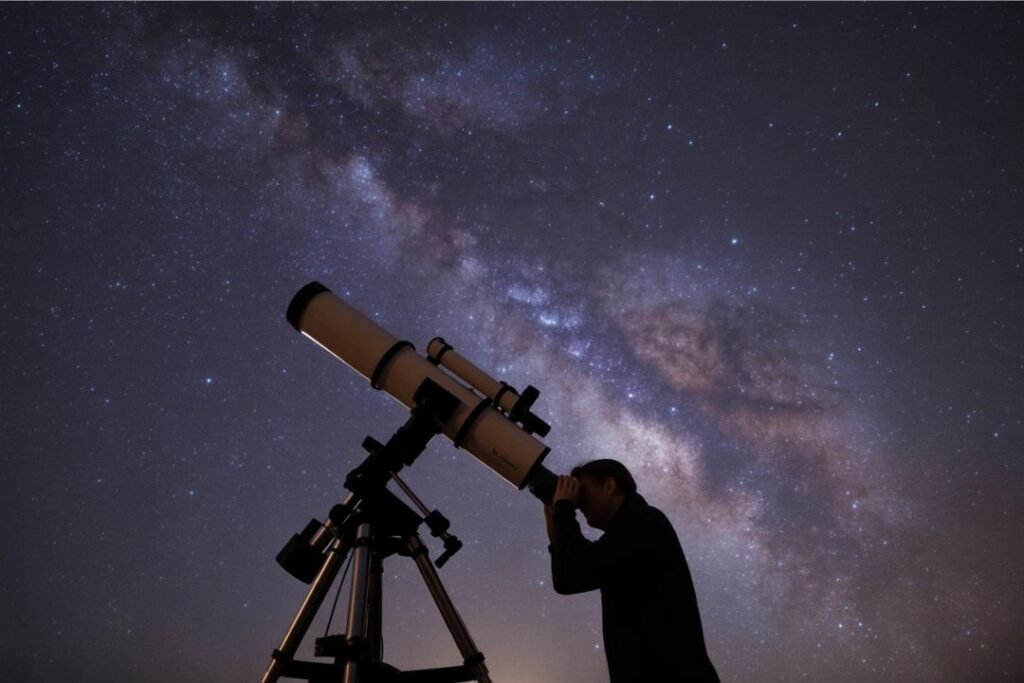
(Conclusion)
Astronomical observation allows us to understand the vastness of the universe, the reality of stars and planets, and our place in it. Modern telescopes and advanced instruments have made this knowledge accessible for both public observation and scientific research.Data obtained from observation contributes to science, technology, and human understanding. Thus, astronomical observation not only satisfies our curiosity but also advances human knowledge.