Supervised Learning: Introduction and Historical Background
Artificial Intelligence has become a very important technology in today’s world. It has various sub-fields, one of the most widely used of which is Machine Learning. Machine learning gives computer systems the ability to learn on their own and make better decisions based on data.There are several methods for this, and among them, Supervised Learning is the basic and most widely used method.
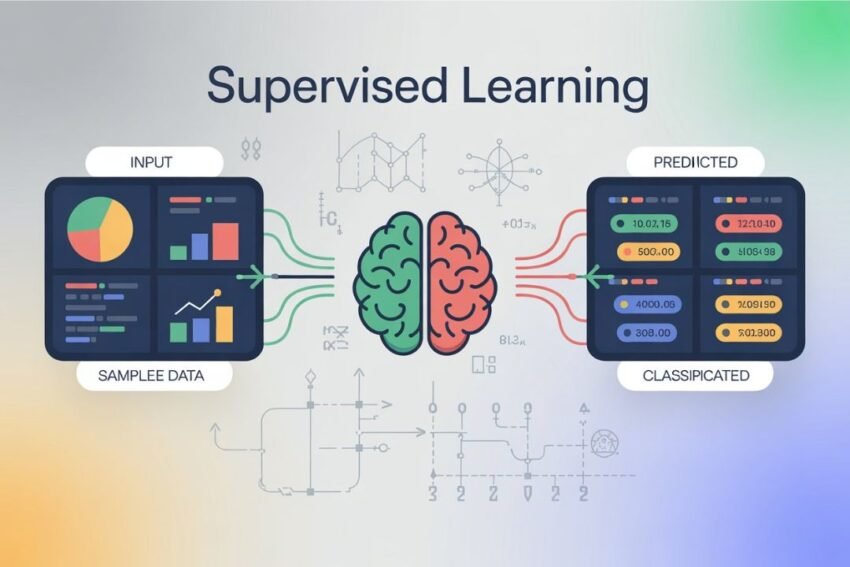
Supervised Learning is a method in which a machine is given pre-labeled data. Through this data, the machine learns what output can be expected according to the given input. In simple words, it is the process of learning under human supervision, where the machine is also told the correct answer with each example.
For example, if we were to teach a computer to recognize dogs and cats in images, we would give it thousands of images that were pre-labeled with which animal it belonged to. The machine would use this data to learn patterns and gain the ability to correctly identify new, previously unseen images.
Historical background
Supervised Learning has its roots in Artificial Intelligence and Statistics. In the 1950s, when computer science was born, researchers began developing algorithms that could learn from data. In the early days, this work was based on basic regression and classification methods.
Research on Decision Trees and Neural Networks grew in the 1970s and 1980s, broadening the scope of Supervised Learning. After 1990, the increase in data availability and the development of computing power made Supervised Learning popular on an industrial and commercial level. Today, the technology is being used in automated systems, healthcare, finance, and marketing.
The importance of supervised learning
- Accurate predictions: Supervised Learning systems are capable of drawing accurate conclusions from complex data.
- Automated decision-making: They can make decisions without human intervention.
- Widespread use: It is used in almost every field, such as medicine, finance, and technology.
In short, Supervised Learning is not only a fundamental part of machine learning but also the foundation of modern AI systems.
Types of Supervised Learning
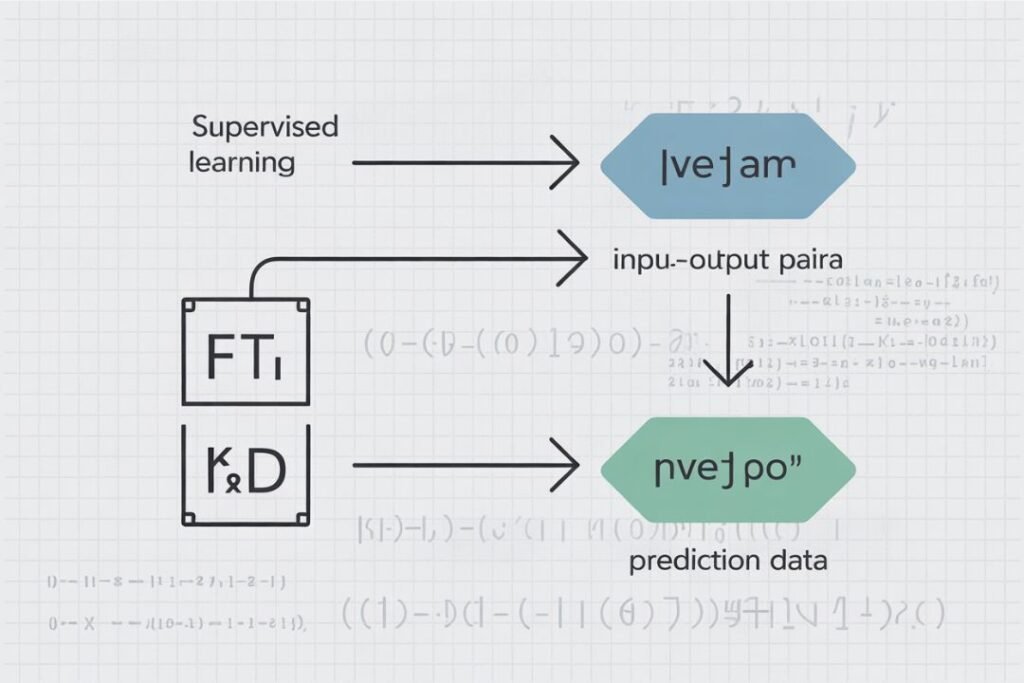
There are two basic types of Supervised Learning:
- Regression
- Classification
Both of these types enable machines to solve different types of problems. Let’s understand each in detail.
Regression
The purpose of regression is to predict continuous outcomes. In this, the machine is trained on data whose output value is numerical.
Examples:
- Predicting the temperature of a city
- Predicting stock market rates
- Predicting the price of a property
Main Regression Algorithms:
- Linear Regression:
- This is the simplest and most common regression technique. Here we assume that the relationship between the output and the input is linear.
- Polynomial Regression:
- When the relationship is not linear and the data is complex, we use polynomial regression.
- How it works:
Regression involves the machine learning a function or formula from previously given input and output data, so that it can make accurate predictions on new data.
Classification
The purpose of classification is to divide data into different categories. Here the output is one of a specific class or label.
Examples:
- Classifying an email into “Spam” or “Not Spam”
- Identifying an animal (dog or cat) in an image
- Diagnosing a disease based on a patient’s symptoms
Main Classification Algorithms:
- Logistic Regression:
This is the basic technique used for binary class (two-category) problems. - Decision Trees:
This is a tree-like model that represents each decision in a node. - Random Forest:
This is a collection of several Decision Trees that are used to increase accuracy. - Support Vector Machines (SVM):
This algorithm finds the best line or hyperplane to separate data into different classes. - How it works:
In classification, the machine is trained on previously labeled data, and then tries to classify new data into the correct class.
Important algorithms of Supervised Learning
Supervised Learning uses several algorithms, which are suitable for different problems. Understanding these algorithms makes it easier for us to decide which algorithm is best for which problem.
Linear Regression
Linear regression is the simplest and most basic algorithm. It assumes a straight and linear relationship between input and output.
How it works:
In linear regression, the machine represents the data by a line, so that the output can be predicted for any new input.
Examples:
- Predicting a country’s GDP
- Predicting stock market prices
- Determining the value of a property
Logistic Regression
Logistic regression is mainly used for classification, especially for binary classes.
How it works:
This algorithm uses input variables to decide which class a new data item falls into. The result is always a probability between 0 and 1.
Examples:
- Classifying an email as Spam or Not Spam
- Diagnosing a patient’s disease (Positive/Negative)
Decision Trees
Decision trees are a tree-like model in which each node is a question or decision, and each branch represents a possible answer. Finally, each leaf represents a class or value.
Advantages:
- Easy and clear to understand
- Can easily show complex data relationships
Examples:
- Determining creditworthiness
- Which customers to target for marketing
Random Forest
A Random Forest is a collection of many Decision Trees. This algorithm combines the feedback from the trees to produce more accurate and robust results.
Advantages:
- More accurate results
- Reduces overfitting problems
- Suitable for large and complex data
Examples:
- Diagnosis of diseases in the healthcare sector
- Customer preferences for online shopping
Support Vector Machines (SOM)
SVM finds the best line or hyperplane to divide data into different classes. This algorithm is especially effective for high-dimensional data.
Advantages:
- Efficient for complex data sets
- Can also handle nonlinear relationships
Examples:
- Image recognition
- Text and spam filtering
Neural Networks
Neural networks are inspired by the structure of the human brain and are used to solve complex problems. These algorithms are ideal for very large data sets and nonlinear relationships.
How it works:
A neural network has several layers (input, hidden, output). Each layer contains nodes (neurons) that process information.
Examples:
- Obstacle recognition in self-driving cars
- Voice and face recognition
- Natural language processing (NLP)
FAQs for Supervised Learning
What is Supervised Learning?
Supervised Learning is a machine learning technique in which a computer is given pre-labeled data. The machine learns based on this data and makes accurate results or predictions for new inputs.
What is the difference between Supervised Learning and Unsupervised Learning?
- Supervised Learning: Pre-labeled data is used and the machine is told the correct answer.
- Unsupervised Learning: Unlabeled data is used and the machine finds patterns and groups on its own.
What are the main algorithms of Supervised Learning?
- Linear Regression
- Logistic Regression
- Dexion Trace
- Random Forest
- Support Vector Machines (SVM)
- Neural Network
Where is Supervised Learning used?
- Disease diagnosis in healthcare
- Stock forecasting in finance
- Customer analysis in marketing
- Identifying bottlenecks in self-driving cars
- In spam filtering and chatbots
What are the limitations of supervised learning?
- Requires large and accurately labeled data
- Data errors or noise can degrade the model
- Overfitting problems can occur
- Sometimes ineffective for new or unusual data
(Conclusion)
Supervised Learning is a basic and effective method of machine learning. It provides the machine with pre-labeled data and gets accurate results on new inputs. Regression and Classification are its two main aspects which are used for continuous numerical prediction and data categorization.Various algorithms such as Linear Regression, Decision Trees, Random Forest, SVM, and Neural Networks, extend the power of Supervised Learning and apply it to fields such as health, finance, marketing, and technology.