Introduction: The Importance of Deep Space Missions
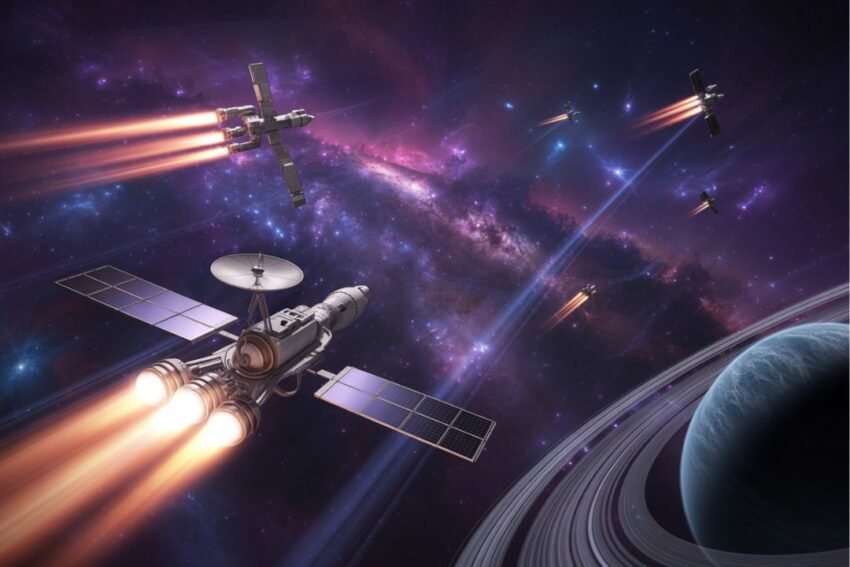
Humans have always been fascinated by the vastness of space. The world beyond Earth’s atmosphere has provided an incredible impetus for human curiosity, scientific exploration, and technological advancement. Deep Space Missions are missions planned to go beyond Earth’s orbit, into our solar system, or even beyond.These missions not only provide information about our planet and other celestial bodies, but also take human science, technology, and understanding of our universe to new heights.
The importance of Deep Space Missions can be gauged from the fact that these missions travel millions of kilometers from Earth and provide us with valuable information about planets, their atmospheres, moons, stars, and other celestial bodies. Our current knowledge about Mars, Jupiter, Saturn, and other planets is based on these missions.
History of Deep Space Missions
The history of deep space missions dates back to the mid-twentieth century, when humans began developing modern rockets and space-going machinery. Early missions were generally conducted for basic space exploration, exploring the Moon and other nearby planets.
Early missions
- Pioneer Missions: These missions began in the 1970s. Pioneer 10 and 11 were the first space missions to go beyond Earth’s orbit and observe Jupiter and Saturn. They not only provided information about distant planets but also laid the groundwork for future deep space missions.
- Voyager Missions: The Voyager 1 and 2 missions were launched in 1977. These missions are still operating today and are providing information about the outer reaches of our solar system. The Voyager missions collected valuable information not only about the conditions of the planets but also about their moons and magnetic fields.
Notable historical achievements
- Mars Robotic Missions: Early Mars missions such as Mariner 4 sent back the first images of the Martian surface to Earth.
- Moon Missions: The Luna and Surveyor missions played a key role in lunar surface exploration and preparation for human missions.
- Hubble Space Telescope: Launched in 1990, Hubble transformed our understanding of the universe. It not only provided images of stars and galaxies, but also raised the standard of our research in astronomy to new heights.
Failed missions and lessons
Not every mission was a success. Many failed due to technical glitches, navigation problems, or other unforeseen reasons. But each failure taught scientists new lessons for future deep space missions.
Summary
The early Deep Space Missions not only expanded our understanding of the solar system, but also demonstrated that humans can reach the vastness of space through their hard work, exploration, and technology. These missions continue to serve as a guide for more complex and longer missions in the future.
Current Deep Space Missions
Overview of Current Deep Space Missions
Deep Space Missions today are more complex and informative than ever before. Using advanced technology, artificial intelligence, and automated robotic systems, these missions travel millions of kilometers above Earth to collect data. NASA, the European Space Agency (ESA), Japan, India, and other space agencies have launched several missions in the current era.Which are adding to our knowledge about Mars, Jupiter, Saturn, and other planets.
NASA missions
Mars Personal Rover:
The latest rover to be sent to Mars includes advanced sensors, cameras, and even a helicopter (Ingenuity). The mission is exploring the Martian surface, soil, and possibly traces of ancient life. It is an example of how advanced technology is being used for missions far from Earth in Deep Space Missions.
Juno Mission:
This mission sent to Jupiter is used to study Jupiter’s atmosphere, magnetic field, and gas layer. The data obtained by Juno has given us valuable information not only about Jupiter but also about other gas planets.
This mission sent to Jupiter is used to study Jupiter’s atmosphere, magnetic field, and gas layer. The data obtained by Juno has given us valuable information not only about Jupiter but also about other gas planets.
This mission to Pluto and the Kuiper Belt is a milestone in the world of Deep Space Missions. New Horizons sent the first detailed images of Pluto back to Earth and revealed new facts about the distant planets.
European Space Agency (ESA) missions
ESA has sent several missions to Mars, Jupiter, and other planets in Deep Space Missions.
- Rosetta Mission: This mission reached Comet 67P/Churyumov-Gerasimenko and provided important information about it. The success of the Rosetta mission proved the usefulness of Deep Space Missions internationally.
- ExoMars: ESA sent the ExoMars rover to search for signs of life and underground water on Mars.
Missions of Japan and India
- Hayabusa2 (Japan): This mission reached the asteroid Ryugu and returned its samples to Earth.
- Chandrayaan-2 (India): The Indian space agency ISRO sent this mission to study the Moon, which included an orbiter and a lander.
The Role of Deep Space Missions in the Exploration of Mars, Jupiter, and Saturn
Deep Space Missions have revealed countless facts about Mars, Jupiter, Saturn, and other planets:
- Signs of ancient rivers and water on Mars
- The complexity of Jupiter and Saturn’s magnetic fields and moons
- Studies of the planets’ atmospheres, temperatures, and chemical composition
These missions help scientists on Earth understand how the various bodies in the solar system came into being, and what the possibilities for life beyond Earth might be.
The role of robotic probes and instruments
Robotic probes and advanced instruments play a central role in all current deep space missions. These probes are either fully controlled from the ground or operate autonomously. With the help of advanced cameras, spectrometers, and other sensors, these missions collect data at all times. For example:
- Mars rovers (Curiosity, Perseverance) send data to Earth
- Juno mission images and magnetic data reach scientists on Earth
- Hayabusa2 succeeds in bringing asteroid samples back to Earth
Summary
Modern-day deep space missions have expanded the boundaries of our knowledge of the universe. These missions are important not only for scientific research but also for the advancement of human technology, AI, and space robotics. These missions to Mars, Jupiter, Saturn, and other planets are a shining example of how humans can expand their knowledge beyond Earth.
Future Deep Space Missions
The importance of future deep space missions
Deep Space Missions, past and present, have provided a wealth of information about our universe, but future missions are about to begin a new journey for humanity. The goal of these missions is not just to obtain data, but to expand human presence in the solar system and enable human exploration beyond Earth.
Human spaceflight missions
Human missions are set to play an increasingly important role in deep space missions in the coming decades. NASA and other space agencies are focused on making it possible for humans to live on Mars, the Moon, and other planets:
Aartimus Program:
This is NASA’s plan to return humans to the Moon. The Artemis program aims not only to explore the Moon but also to provide the infrastructure for future Mars missions.
Like Mars missions:
Several agencies have begun planning for human missions to Mars. These missions will include advanced life support systems, radiation shields, and automated robotic support systems. Human missions to Mars will mark a new chapter in the history of Deep Space Missions.
The role of AI and automated missions
- Artificial intelligence (AI) and automated systems will play an increasingly important role in future deep space missions:
- Missions will include autonomous navigation and decision-making capabilities, so that probes can make decisions automatically based on the situation.
- AI will help collect data, monitor the environment, and assess risks for human missions to Mars or other planets.
- Automated robotic systems will create the infrastructure for a human presence on Mars or other planets, such as habitats, energy sources, and resource extraction systems.
Deep Space Missions – Frequently Asked Questions (FAQ)
What are Deep Space Missions?
Deep Space Missions are space missions sent beyond Earth’s orbit, into the solar system, or beyond. The goal of these missions is to obtain information about planets, moons, stars, and other celestial bodies, to advance human exploration, and to advance technology.
What missions are included in the current Deep Space Missions?
Current Deep Space Missions include several important missions, such as:
- Mars Perseverance Rover – to study the surface and soil of Mars
- Juno Mission – to study Jupiter’s atmosphere and magnetic field
- New Horizons – to explore Pluto and the Kuiper Belt
- Rosetta and ExoMars (ESA) – to explore comets and Mars
- Hayabusa2 (Japan) – to return asteroid samples to Earth
What are the plans for future Deep Space Missions?
Future Deep Space Missions will increasingly focus on human spaceflight and robotic missions:
- Artemis Program – Returning humans to the Moon
- Human missions to Mars
- Automated exploration through AI and robotic systems
- Searching for signs of life on moons like Europa and Titan
Potential interstellar probes that will bring information beyond the solar system
Are human missions to Mars possible in the future?
Yes, human missions to Mars are possible in future Deep Space Missions. NASA, ESA, and other agencies have developed plans to send humans to Mars. These missions would include the development of advanced life support systems, radiation shields, robotic support, and habitats.
Are Deep Space Missions only for scientists?
No. Although Deep Space Missions are primarily for scientific research, their impact reaches every human being:
- Development of advanced technology and equipment
- Support for education and research
- Public awareness of the Earth and the universe
- Opportunities for new industries and scientific jobs
(Conclusion)
Deep Space Missions have revolutionized human knowledge, science, and technology. These missions not only reveal the secrets of Mars, Jupiter, and other planets, but also increase the possibilities of human spaceflight and life in the future. Current and future missions allow us to understand the vastness of the universe, use advanced technology,And provide the opportunity to make human exploration beyond Earth possible.