
Introduction Machine Learning
In today’s digital age, technology has impacted every aspect of life. The internet, mobile apps, automated systems, and data science have transformed our daily routines. Behind all these innovations, there is a fundamental pillar that we know as Machine Learning.Machine Learning is an important area of Artificial Intelligence that gives computers the ability to learn and make decisions without explicit programming.
In simple terms, Machine Learning is a process in which computers automatically learn based on their experiences and data and make better future decisions. It does not think like a human, but rather recognizes patterns in data and produces results.
Definition of Machine Learning
The general definition of Machine Learning is:
“Machine Learning is a branch of computer science that gives computer systems the ability to learn and make better decisions without explicit programming.”
This definition makes it clear that in Machine Learning, the programmer does not code every small step, but the computer is given the ability to learn on its own through algorithms.
Importance of Machine Learning
The importance of Machine Learning is increasing in today’s era. Here are some important reasons:
- Growing volume of data
Today, the world is generating an enormous amount of data every moment. Analyzing this data, finding patterns, and extracting meaningful information from it is only possible with the help of Machine Learning. - Better decision-making
Computers can make better and faster decisions based on Machine Learning in business, health, finance, and other fields. - Automated processes
Machine Learning systems can perform complex tasks without human intervention, such as email filtering, spam detection, or road sign recognition in autonomous vehicles. - Problem-solving ability
Traditional programming can only solve known problems, but Machine Learning can also work on new and unexpected problems.
Basic types of Machine Learning
Machine Learning is generally divided into three main types:
Supervised Learning
In this, the model is given pre-labeled data so that it can learn patterns. For example, if we need to classify emails into “Spam” or “Not Spam”, the model is given a number of emails in advance along with their categories so that it can classify new emails in the future.
Unsupervised Learning
In this, the model is given unlabeled data and it finds groups or patterns on its own. For example, in marketing, creating groups of customers to identify their purchasing tendencies.
Reinforcement Learning
In this type, the model learns from the results of its decisions. Each successful outcome gives the model positive feedback and each failure negative. In this way, the model improves over time. It is most commonly used in autonomous vehicles, computer games programs, and robotics.
How does Machine Learning work?
The basic process of Machine Learning consists of the following steps:
- Data collection
First, data is collected according to the problem. This data can be in various forms, such as text, images, videos, or sensor data. - Data preparation
The collected data often contains errors or unnecessary information. It is necessary to clean and standardize it so that the model can learn better. - Model Selection
There are different types of Machine Learning algorithms, such as Decision Trees, Neural Networks, or Support Vector Machines. It is important to choose the right model according to the problem. - Model Training
The selected model is trained with data so that it can learn patterns. - Testing the model
After training, the model is tested on new data to see how accurate it is. - Applying the results
Finally, the model is put to practical use, such as filtering spam emails or recommending products to users.
Machine Learning and Artificial Intelligence
Machine Learning and Artificial Intelligence are often used interchangeably, but there is a difference between the two.
- Artificial Intelligence (AI): The ability to give computers human-like abilities, such as decision-making, problem-solving, and language understanding.
- Machine Learning (ML): A subset of AI that gives computers the ability to learn on their own and make better decisions.
Simply put, AI is a big field, and ML is one of the powerful tools within it.
Types, algorithms and practical uses of Machine Learning
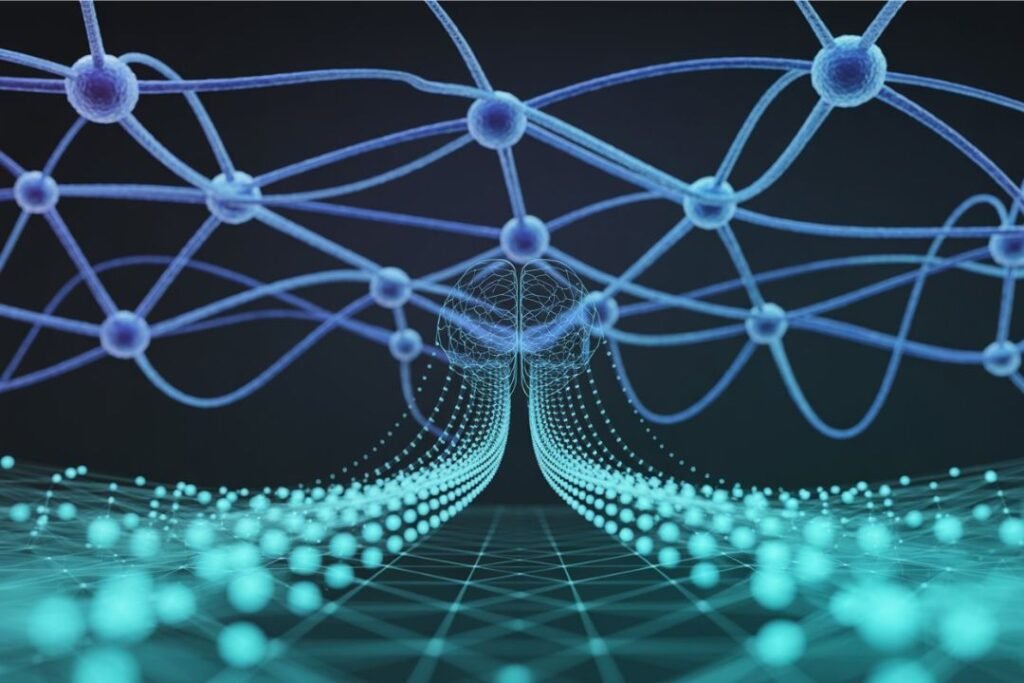
Types of Machine Learning
Machine Learning is generally divided into three basic types, which are useful in different ways in each field:
Supervised Learning
Supervised Learning is a type of learning in which a model is given pre-labeled data. The goal is for the model to make accurate predictions on new data.
Examples:
- Identifying emails as “Spam” or “Not Spam”
- Predicting consumer purchasing trends
- Diagnosing diseases, such as diabetes
Popular algorithms in Supervised Learning:
Linear Regression: Making predictions based on numerical data, such as estimating the value of a property.
- Logistic Regression: For dividing into two or more classes, such as whether a person has a disease or not.
- Decision Trees: Dividing data into decision branches.
- Random Forest: A collection of Decision Trees, which makes the results more stable and accurate.
- Support Vector Machines (SVM): Used for classifying complex data.
Unsupervised Learning
In Unsupervised Learning, the model is given unlabeled data. The goal is to discover hidden patterns and groups in the data.
Examples:
- Segmenting consumers into groups to improve marketing
- Identifying patterns in data for market research
- Identifying trends and tendencies on social media
Popular Algorithms in Unsupervised Learning:
- K-Means Clustering: To divide data into groups or clusters.
- Hierarchical Clustering: To discover hierarchical relationships in data.
- Principal Component Analysis (PCA): To easily understand large data by converting it into low-dimensional data.
Machine Learning – Future Trends and Challenges
Future Trends
Machine Learning is growing rapidly and in the future this technology will revolutionize every field. Some of the key trends are as follows:
- Autonomous Vehicles and Transportation
In the future, machine learning will play a key role in autonomous vehicles and driverless technology. Vehicles will make better decisions by analyzing road conditions, traffic signals, and the behavior of other vehicles. - Revolutionizing Healthcare
Machine Learning will accelerate disease prediction, medical image recognition, and drug discovery. It will significantly improve the way patients are diagnosed and treated. - Personalized Learning in Education
Machine Learning in education will analyze students’ learning styles and tendencies, and create a specific learning plan for each student. - Personalized Recommendations in Business and Marketing
Machine Learning in business will analyze consumer behavior and provide personalized product or service recommendations, increasing business sales and customer satisfaction. - Security and Fraud Detection
In the future, Machine Learning models will be more effective in the area of security, such as credit card fraud, cyber attacks, and protecting sensitive data.
Machine Learning Challenges
Although the possibilities of Machine Learning are vast, there are also some challenges:
- Data Quality and Quantity
For better results, the model needs more and better quality data. Poor or unbalanced data can affect the model’s decisions. - Privacy and Security
Machine Learning uses sensitive information, which can raise privacy and security issues. - Model Interpretability
Some models, such as Neural Networks, are complex and their decisions are difficult to understand, which creates issues of trust and accountability. - Bias & Fairness
If human bias is present in the data, the decisions of a Machine Learning model can also be unfair. - Lack of technology and skills
Modern machine learning systems require experts to develop and maintain, and the lack of trained people in this field can be a challenge.
Summary
In the future, Machine Learning technology will bring significant progress in every field, but it will also be necessary to solve the problems of data quality, privacy, bias, and expertise. This technology, if used correctly, can revolutionize health, education, business, technology, and security.
Frequently Asked Questions (FAQs) about Machine Learning
What is Machine Learning?
Machine Learning is the branch of computer science that gives computers the ability to learn and make decisions without explicit programming. In it, the computer learns patterns from data and improves future decisions.
What is the difference between Machine Learning and Artificial Intelligence?
- Artificial Intelligence (AI): The science of giving computers human-like abilities, such as decision-making, language understanding, and problem-solving.
- Machine Learning (ML): A subset of AI that gives computers the ability to learn on their own and make better decisions.
Simply put, AI is a big field, and ML is one of the powerful tools within it.
What are the types of Machine Learning?
Machine Learning can be divided into three basic types:
- Supervised Learning – trains a model with labeled data.
- Unsupervised Learning – finds patterns and groups in unlabeled data.
Reinforcement Learning – learns from the results of experiments, with each successful decision providing positive feedback.
What are the popular Machine Learning algorithms?
Machine Learning uses various algorithms, such as:
- Linear Regression
- Decision Trees
- Random Forest
- Neural Networks
- K-Means Clustering
- Support Vector Machines (SVM)
These algorithms help the model learn from data and make better decisions.
Where is Machine Learning used?
Machine Learning is used in almost every field, such as:
- Health: Disease prediction and diagnosis
- Business: Consumer trends and personalized product recommendations
- Technology: Autonomous vehicles and voice assistants
- Education: Analyzing student learning trends
- Security: Fraud detection and cybersecurity
(Conclusion)
Machine Learning is one of the most important technologies of today, giving computers the ability to learn from data and make better decisions. It is revolutionizing every field, including health, business, education, security, and technology. If quality data and modern algorithms are used, Machine Learning will create immense opportunities and convenience for humanity in the future.