(Introduction)
Space Exploration is the greatest example of human curiosity. Throughout human history, the sky, stars, and planets have always fascinated humans. Thousands of years ago, people looked up at the night sky and wondered what was beyond Earth. This curiosity is still the basis of Space Exploration today.
Space exploration not only increases human knowledge, but also plays a significant role in science, technology, and the economy. It takes humans beyond the confines of Earth and opens up new possibilities, such as human missions to Mars, exploration of the Moon, and the study of other planets.
The beginning of human curiosity and space exploration
Human curiosity has always been directed towards the sky. Ancient civilizations such as the Egyptians, Mesopotamians, and Greeks studied the stars, planets, and the movements of the sun and moon. Their goal was not only to determine time and weather, but also to understand what was beyond Earth.
In the early days, by observing the sky, man began to understand the principles of the universe and the laws of motion of the stars. These observations later became the basis for space exploration.
Space Exploration missions
The modern era of space exploration began in the 20th century. In 1957, the Soviet Union made history by sending Sputnik 1 into Earth’s orbit. It was the first satellite, which gave humanity the courage to step into space.
Then, in 1961, Yuri Gagarin sent the first human into space, making it clear that space exploration was possible not just theoretically but also on a practical level.
Technological Advances in Space Exploration
The most important factor in space exploration is technology. The development of rocket technology, satellites, and spacesuits enabled humans to travel beyond Earth’s gravity. In modern times, companies like SpaceX and Blue Origin have revolutionized the field, making human missions and the exploration of Mars possible.
Current trend of Space Exploration
Today, Space Exploration is no longer just the work of scientists, but has become a global hub of investment, technology, and research. NASA, Russia, China, and other countries are continuously conducting space missions. Through Space Exploration, we are not only understanding the planets and stars, but also exploring new possibilities for life on Earth.
Space Exploration: Modern-day space programs and human missions
The beginning of modern Space Exploration
Space exploration took a new turn in the mid-20th century. The Space Race between the Soviet Union and the United States shocked the world. During this era, humanity first truly set foot in space.
The Soviet Union pioneered human space travel with Sputnik 1 in 1957 and then Yuri Gagarin in 1961. In response, the United States established NASA and landed humans on the moon in 1969 through the Apollo missions. This moment is a golden chapter in the history of space exploration.
NASA and American space missions
NASA’s goal was not only to conduct research in space, but also to advance science and technology on Earth. The Apollo program landed humans on the moon, and conducted numerous missions to understand the Earth’s atmosphere, planets, and the laws of space.
Additionally, NASA began studying Mars by sending Mars rovers. These missions open up new possibilities for human life through space exploration, such as water, food, and future human population transfers outside Earth.
Space Exploration of Russia and other countries
Russia played a significant role in space exploration even after the Soviet Union. Russian space stations, missions, and technology encouraged other countries around the world to invest in this field.
China has also made significant strides in space exploration in the modern era. The Chang’e missions explored the moon, and China’s Mars mission solidified its position in space exploration globally.
Role of private companies
- In recent years, private companies have revolutionized space exploration. Companies like SpaceX, Blue Origin, and Virgin Galactic have made space travel affordable, safe, and sustainable.
- SpaceX launched the first human mission as a private company.
- Launching robotic missions to explore Mars, satellites to monitor Earth, and new opportunities for space tourism have opened up.
Technological Advances in Space Exploration
The role of modern technology behind the success of Space Exploration is very important:
- Rocket technology – advanced rockets to go beyond the Earth’s gravity
- Spacesuits – enabling humans to live in space
- Satellites and robotic missions – for studying Mars and other planets
- Data and communication technology – transmission of information in space
- Recycling and Support Systems – For Longer Durations in Space
These technologies are not only essential for space exploration but also improve everyday life on Earth, such as weather research, telecommunications, and advanced transportation systems.
Human Missions in Space Exploration
Human missions have always been the most important aspects of space exploration. Landing on the Moon, exploring Mars, and conducting research in space stations are all part of this.
- Apollo missions: Landing humans on the Moon and exploring the lunar surface
- Mars rovers: Studying the surface and atmosphere of Mars
- International Space Station (ISS): Long-term research and collaboration in space
These missions revolutionized human knowledge and opened up new possibilities for future space exploration, such as human settlements on Mars, energy sources in space, and the use of planetary resources.
Space Exploration: Space Exploration and Benefits of Mars and Other Planets
Exploring Mars
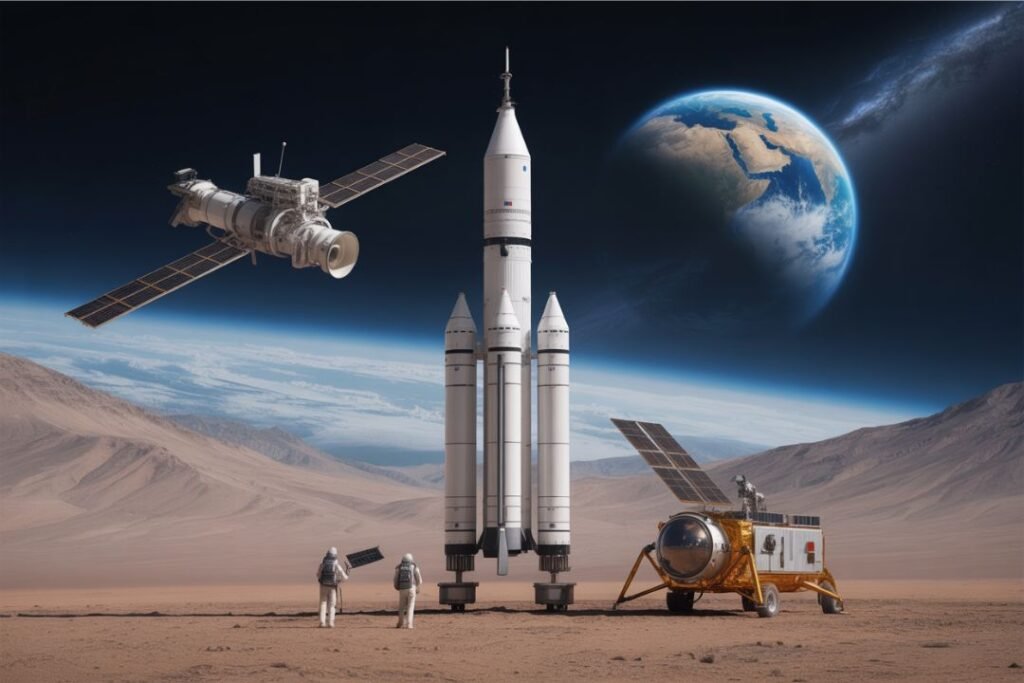
Mars exploration is a hot topic in space exploration. Mars, also known as the “Red Planet,” has been a major topic of human curiosity. Numerous missions have been sent to search for water, an atmosphere, and possible life on Mars.
- Mars Rovers: NASA’s “Curiosity” and “Perseverance” rovers conducted various experiments on the surface of Mars.
- Missions from China and the United Arab Emirates: Participating in research into the atmosphere and geography of Mars.
These missions not only provide information about the surface and atmosphere of Mars, but are also essential for preparing Mars for future human settlement. Through space exploration, we can understand the extent to which human life is possible outside of Earth.
Research of other planets and satellites
Space Exploration is not limited to Mars. Other planets, such as Jupiter, Saturn, Uranus, and Neptune, as well as their moons, are also part of the research.
- Geonoid and robotic missions have studied Saturn and its moons, such as Titan and Enceladus.
- Research on planets and moons helps us understand Earth’s environmental processes, water sources, and potential human settlements.
- These missions are not only important for science, but space exploration also helps us conserve Earth’s resources and prepare for the future.
Advantages of space exploration
Humanity has benefited from space exploration in many ways:
- Advances in science and technology: Revolutions in rocket technology, satellites, and data systems
- Improvements in daily life: GPS, weather forecasting, and communication
- Economic benefits: Establishment of private space companies and development of the space industry
- Opportunities in Education and Research: New Doors of Research for Young Scientists and Engineers
- Possibilities for the Human Future: Human Settlement on Other Planets After Earth’s Resources Are Limited
Space Exploration not only helps in saving resources on Earth but also provides new opportunities to humans in the future.
Future prospects
The future of space exploration is very bright. Scientists and engineers are working on future human settlements, energy sources in space, and the preparation of other planets.
- Space Stations and Bases: For Permanent Habitat in Earth Orbit
- Human Settlements on Mars: For Future Human Population
- Space Energy: New Sources of Solar Energy and Energy Supply for Earth
- Legal and Ethical Aspects: Resource Use in Space and Human Rights
These possibilities open new doors for humanity and make space exploration an essential part of future development.
Frequently Asked Questions (FAQs) about Space Exploration
What is Space Exploration?
Space Exploration refers to the human exploration and discovery of space, planets, moons, and other celestial bodies beyond Earth. It is the combination of human curiosity, science, and technology that helps us understand life, resources, and the principles of the universe beyond Earth.
Why is Space Exploration Important?
The importance of Space Exploration is as follows:
- Advancement in science and technology
- Saving Earth’s resources and preparing for the future
- Human settlements on Mars and other planets
- Economic and educational benefits
- Better understanding of Earth’s environmental conditions
When did space exploration begin?
Space exploration in the modern era began in 1957 with the Soviet Union’s Sputnik 1, the first satellite of the Earth. In 1961, Yuri Gagarin laid the foundation for man’s first step into space, and in 1969, through the Apollo program, man set foot on the moon.
What are the main missions of Space Exploration?
Important missions include:
- Sputnik 1 and Yuri Gagarin missions
- Apollo missions (Moon exploration)
- Mars rovers (Curiosity and Perseverance)
- Chang’i missions (Moon exploration, Chinese missions)
- Long-duration research on the International Space Station (ISS)
What are the benefits of Space Exploration?
The benefits of Space Exploration are as follows:
- Development of modern technology
- Improvement in the quality of life on Earth
- Economic development and the development of the private space industry
- New doors for educational opportunities and research
- New opportunities for the future human population

(Conclusion)
Space exploration is the highest example of human curiosity and knowledge. It not only unlocks the secrets of the universe, but also provides countless benefits in science, technology, and human life. The exploration of Mars, the Moon, and other planets plays an important role in the future development and conservation of Earth’s resources, and illuminates new possibilities for humanity.