Interstellar Travel: Mankind’s Greatest Space Quest
Human nature has always had a desire to understand the unseen and unknown. When we look up at the sky, we are captivated by the stars, galaxies, and vastness of space. This same curiosity has led us to venture beyond the confines of Earth and into interstellar travel.
Definition of Interstellar Travel
Interstellar travel is a concept in which human or robotic missions attempt to reach our galactic neighbors or other stars from Earth. It differs from conventional spaceflight, as space missions in orbit around Earth are typically limited to a few thousand kilometers, while interstellar travel involves distances of hundreds of millions or billions of kilometers.
Interstellar distances
The closest star to Earth, Proxima Centauri, is about 4.24 light-years away. This means that even light takes more than four years to travel that distance. For human or robotic spacecraft, these distances are extremely challenging, as with current technology it would take us thousands of years.
The purpose of Interstellar Travel
The purpose of this journey for humanity is not just to cover distance, but to expand knowledge, survival, and future possibilities. Some of its primary objectives are as follows:
- Science and research: Studying planets in other star systems.
- Human survival: Finding new homes for humanity to survive in the face of natural or environmental crises on Earth.
- Technological Advancement: Bringing about new revolutions in space technology.
- Spiritual and Philosophical Quest: Increasing understanding of human place and existence in the universe.
Historical background
Humanity’s dream of interstellar travel dates back centuries.
Ancient concept
Human interest in the sky and stars has always existed in ancient cultures. Greek, Chinese, and Arab astronomers observed the movement of stars, but this was limited to philosophical and mathematical interest.
The role of science fiction
In the 19th and 20th centuries, science fiction brought the dream of interstellar travel closer to reality. Julius Verne, H.G. Wells, and later Stephen Hawking presented ideas of space travel and expeditions to other planets. These stories and ideas not only piqued the interest of the public but also provided inspiration for scientists.
Modern research
The late 20th and early 21st centuries saw practical steps in research into interstellar travel. NASA, ESA (European Space Agency), and private companies such as SpaceX began not only sending missions beyond Earth’s orbit, but also considered the possibility of reaching other stars in the future.
Current technology and challenges
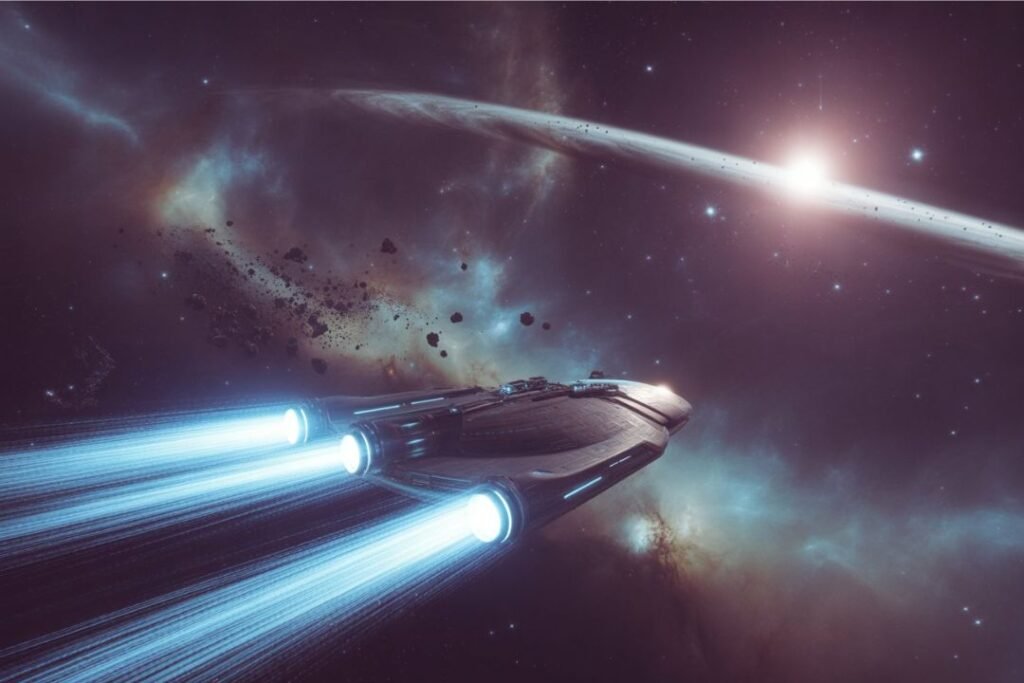
Interstellar Travel is not easy to implement. It has several challenges:
Energy requirement
Interstellar travel requires a lot of energy. This is not possible with current rocket fuels and traditional chemical fuels. Nuclear-thermal, ionic, and laser-based propulsion systems are being considered important in the future.
Time and distance
Making it possible to travel billions of kilometers in a limited human lifetime is one of the greatest challenges. To solve this problem, scientists are researching theories such as time dilation and hyperspace or wormholes.
Effects on the human body
During long space travel, the human body faces various risks:
- Mechanical effects: weakening of bones and muscles.
- Radiation: damage from cosmic rays in space.
- Psychological problems: isolation and mental stress in a confined environment.
Robotic missions
- Instead of human spaceflight, robotic missions are initially more feasible. For example:
- Voyager 1 and 2: have left Earth’s orbit and entered interstellar space.
- Breakthrough Starshot: A project in which small robotic ships, using lasers, will attempt to reach Proxima Centauri.
Interstellar Travel: Future Technology and Human Missions
Future technology
Scientists are working on several advanced and theoretical technologies to make interstellar travel a reality. These technologies have the potential to solve the problems of energy, speed, and survival.
Laser Propulsion
- Laser propulsion is a cutting-edge concept in which powerful laser beams from Earth can propel spacecraft close to the speed of light.
- The goal is to deliver small, lightweight robotic spacecraft to nearby stars within a few decades.
- The Breakthrough Starshot project is an example of this technology, which aims to reach Proxima Centauri within 20 years.
Ionic and plasma propulsion
- Ionic and plasma systems are more efficient for long-distance space travel than traditional rocket fuel.
- These systems can provide sustained velocity while using less fuel.
- Example of ionic propulsion: NASA’s Dawn Mission, which successfully completed a mission in the Asteroid Belt.
Nuclear thermal propulsion
- In a nuclear thermal rocket, the fuel is heated by a nuclear reactor to achieve greater speed.
- This is more efficient for longer distances.
- One day this technology could also be used for human interstellar travel.
Wormholes and space-time manipulation
- This is still theoretical, but it’s the most exciting concept:
- Wormholes could connect two different points in space, shortening distances.
- If practical, they could allow travel faster than the speed of light.
- Scientists are researching ideas like Einstein-Rosen Bridges and the Alcubierre Drive.
Theories of human missions
Long-term missions
The biggest problem for human interstellar travel is time. Here are some theoretical solutions:
Cryogenic Sleep (Cryosleep):
- Putting humans in an artificial sleep state so that the rate of aging slows down during travel.
- This concept is popular in science fiction, but scientists are trying to make it a reality by conducting experiments.
Generation Ships:
- Spaceships that travel for generations, with people born and dying on board.
- This is the most practical solution if speeds close to the speed of light are not possible.
Plans for human survival
Long space travel puts a lot of strain on the human body and mind:
- Radiation protection:
- Protection systems such as Magnetic Shields or Water Walls can be used.
- Food and water supply:
- Self-sustaining ecosystems, such as Hydroponics and Aquaponics.
- Psychological health:
- Virtual Reality and recreational activities can keep the human mind active.
Combining human and robotic missions
- The combination of humans and robots will be more effective in the future:
- Robotic missions will make initial observations and reduce risks.
- The human team will go when the environment is relatively safe and scientists can do further research.
Possible destinations
Proxima Centauri
- The closest star to Earth, 4.24 light-years away.
- A planet called Proxima b is a possible candidate for human habitation.
- Breakthrough Starshot and other projects are preparing to send robotic missions there.
TRAPPIST-1 system
- Seven Earth-like planets, some of which may have habitable environments with water.
- TRAPPIST-1 is about 39 light-years away, but it is interesting to study.
Other possible planets
- Planets such as Gliese 667Cc, Luyten b, Kepler-452b have also been proposed for long-distance.
- The atmosphere, gravity, and radiation levels of each planet are important for human survival.
Moral and philosophical aspects
Interstellar Travel is not just a matter of technology, but also ethics and philosophy:
- Life preservation: How to protect native life before human settlement on new planets?
- Resource distribution: Why use resources on new planets, leaving aside the problems of Earth?
- The future of humanity: How will the human rights of Generation Ships that will last for generations be protected?
Frequently Asked Questions (FAQs) about Interstellar Travel
What is Interstellar Travel?
Interstellar travel means traveling in space between stars, that is, trying to reach other stars or planets from Earth. It is different from normal space travel because the distances are billions of kilometers and crossing them with current technology is extremely challenging.
What is the purpose of Interstellar Travel?
- Its purpose is not just to travel into space, but also to:
- Explore new planets and systems
- Find new environments for human survival
- Advance in space technology
- Increase human understanding of existence and the universe
Can humans really travel to other stars?
This is not possible with current technology. But in the future, theoretical and practical projects such as laser propulsion, ionic and plasma propulsion, nuclear thermal, and wormholes could pave the way for human or robotic missions.
What is the closest star and is it possible to get there?
The closest star is Proxima Centauri, which is 4.24 light-years from Earth. A planet called Proxima b is considered a candidate for possible human survival there.
What are the effects of space travel on the human body?
Humans face several risks during long space travel:
- Weakening of bones and muscles
- Harm from cosmic rays and radiation
- Psychological stress due to isolation and confined environments
What are Cryogenic Sleep or Generation Ships?
- Cryogenic Sleep: A person is placed in an artificial sleep state so that the rate of aging is slowed during travel.
- Generation Ships: Ships that travel for generations, and people are born and die on board, so that distances can be covered.
(Conclusion)
Interstellar travel is humanity’s largest and most complex space exploration, taking us beyond the limited boundaries of Earth. It not only provides opportunities for the discovery of stars, other planets, and potential new worlds, but also plays a key role in human survival, science, and the advancement of technology.Through a combination of robotic missions, advanced propulsion systems, ion and laser technologies, and future human missions, the concept of interstellar travel is becoming a reality. It not only fuels human curiosity in the universe, but also serves as a means to secure the future of our generations and advance human knowledge.